
Cloud Intelligence™
Using zetaSQL to analyse query syntax for BigQuery
This page is also available in Deutsch, Español, Français, Italiano, 日本語, and Português.


About Eben Du Toit
I lead engineering teams in the Partner Channel space, building the tooling that helps customers make sense of their revenue — turning complex partner and billing data into something they can actually see, trust, and act on. The work sits at the intersection of cloud cost management, FinOps, and billing integrations, with data flowing across GCP, BigQuery, MongoDB Atlas, Snowflake, and the wider cloud ecosystem. It's technically meaty, and I love that about it.
My days are split between people and systems — growing and aligning multiple teams, helping the team navigate the environment, hiring, and partnering with stakeholders across the org. I shift between maker mode and manager mode depending on what's needed: sometimes I'm deep in the code building features, sometimes I'm in the room helping my teams move forward. I care a lot about building teams where good engineers can do their best work.
What I work on
Partner Channel engineering and revenue management tooling · Cloud cost management and FinOps · Billing data pipelines and integrations · Engineering leadership, hiring, and team process
Good topics to find me for
Anything Partner Channel, revenue, FinOps, or billing-related · Data engineering and pipeline architecture · Engineering management, hiring, or team culture
Outside work
When I'm not in a terminal, I'm usually behind a camera — shooting on a Nikon Z or whatever vintage film body I'm currently infatuated with. I follow mountain biking and trail running closely, have strong opinions about mechanical keyboards and good stationery, and watch more anime than I probably admit. I also play Rocket League with more optimism than results.
Cape Town · SAST (UTC+2)
My personal pagePhoto by Reza Rostampisheh on Unsplash
In the world of parsers, the state-of-the-art in text analysis power and functionality lies in a parser that can build an abstract syntax tree (AST) of your text. The main benefit of an AST is that you use a JSON string that contains classifications of the information that you parsed. It is extremely useful and easy for building services on top of. If the input text is a SQL statement, even more so.
Any SQL editor worth its weight in gold uses a parser. superQuery uses a parser called pegJs, a javascript-based system that has been enhanced by the team now acquired by DoiT International to also handle most of Google BigQuery’s syntax efficiently.
About zetaSQL
Early in 2019, Google open-sourced the AST-based parser called zetaSQL that is used in production for parsing and formatting queries in Google BigQuery and Cloud Spanner. The repository is here. zetaSQL can be compiled using bazel and consists mainly of C++ code, although a java implementation is also available.
Diving into the code, the parser has quite a few functionalities, some of which are:
- Formatting a SQL statement (sql_formatter.h)
- Analyzing a SQL statement (analyzer.h)
- Finding syntax errors and returning the error, line, and column to you (parse_helpers.h)
After looking into the repository, we quickly see that it seems easy to build. To save you time, I should point out that the file called .bazelrc is very important, as it sets the C++ compiler version to the correct level, as supported by the other software by Google. So it is of critical importance to have this file during a build.
Also, the base zetaSQL repository doesn’t offer a Dockerfile (yet) which allows you to build and compile the latest version of zetaSQL. I offer it here, based on Ubuntu 18.04 and the latest version of bazel.
My implementation ( zetasql-analyzer-server) solves point 3 above, which is the syntax error finder. It is based on a Docker implementation made by apstndb called the zetasql-format-server (that solves point 2 above). Under the hood it is a golang server that wraps the formatter (or analyzer) api of zetaSQL and serves an endpoint in Google Cloud Run.
Examples
Simple one
Here is an example output from the analyzer endpoint for an erroneous query SELEC 1 (the T is missing):
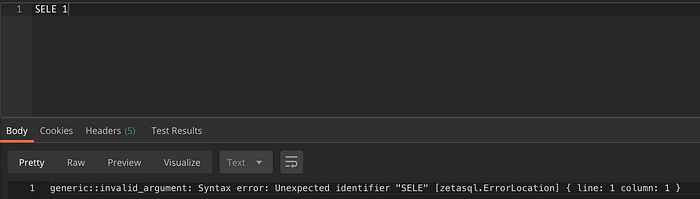
The error location, line and column and error message is returned for a simple query.
Complicated one
In the example below, the second nest of the query is missing the word SELECT . You can see that the parser indicates this information.
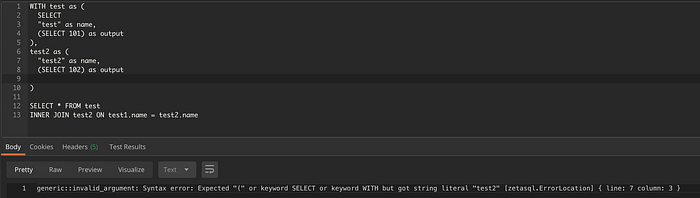
Error location for a bit more complicated query.
What about speed and performance?
From the limited number of tests I’ve performed, it seems most responses (even for queries over 600 rows) stays within 1 second, with the mean of 300ms.
Here are timing graphs for the 2 examples from my laptop, with a high-speed internet connection:
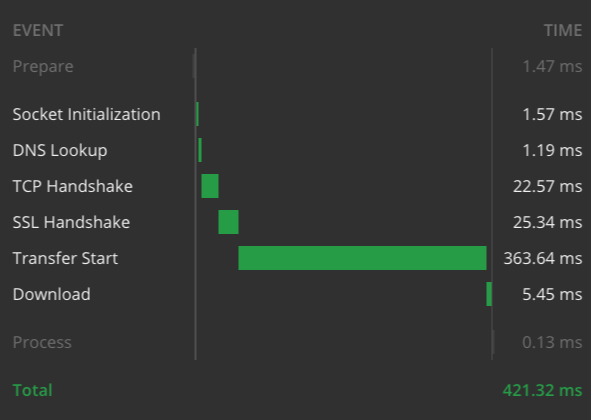
Event turnaround time for “SELE 1"
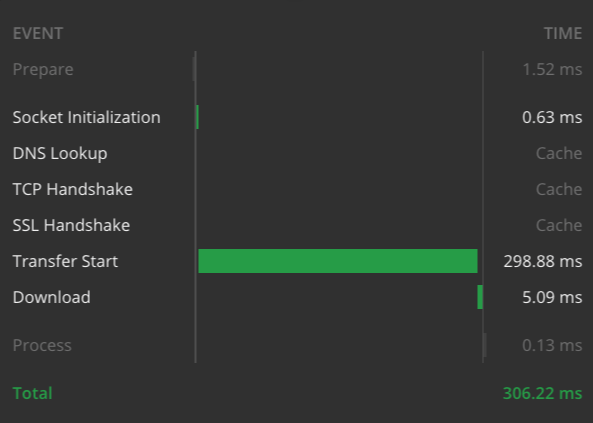
Event turnaround time for the more complicated example above.
The stack that allows this high speed parsing is using adistroless container image ( https://github.com/GoogleContainerTools/distroless) and aserverless hardware implementation (Cloud Run) using C++ as input language.
Cloud bill shouldn't be a mystery
One platform for AI and Cloud optimization.
Installation and Usage
To install this you are welcome to read the README file here. Let me know where I can help to get it going.
After creating an endpoint in Cloud Run, you can get information from it by issuing a curl command:
curl -X POST -H 'Content-type: application/text' --data 'SLECT 1, ' https://<your endpoint goes here>
Lastly
Happy parsing!
References
- zetasql-analyzer-server: https://github.com/ebendutoit/zetasql-analyzer-server
- zetaSQL: https://github.com/google/zetasql
- zetasql-format-server: https://github.com/apstndb/zetasql-format-server


