

know the true Cost of every
True per-Customer Costs
Whether its customers, vendors, partners or agents - visibility into your margins is strategic. Attribute™ calculates cost-to-serve based on real consumption data.
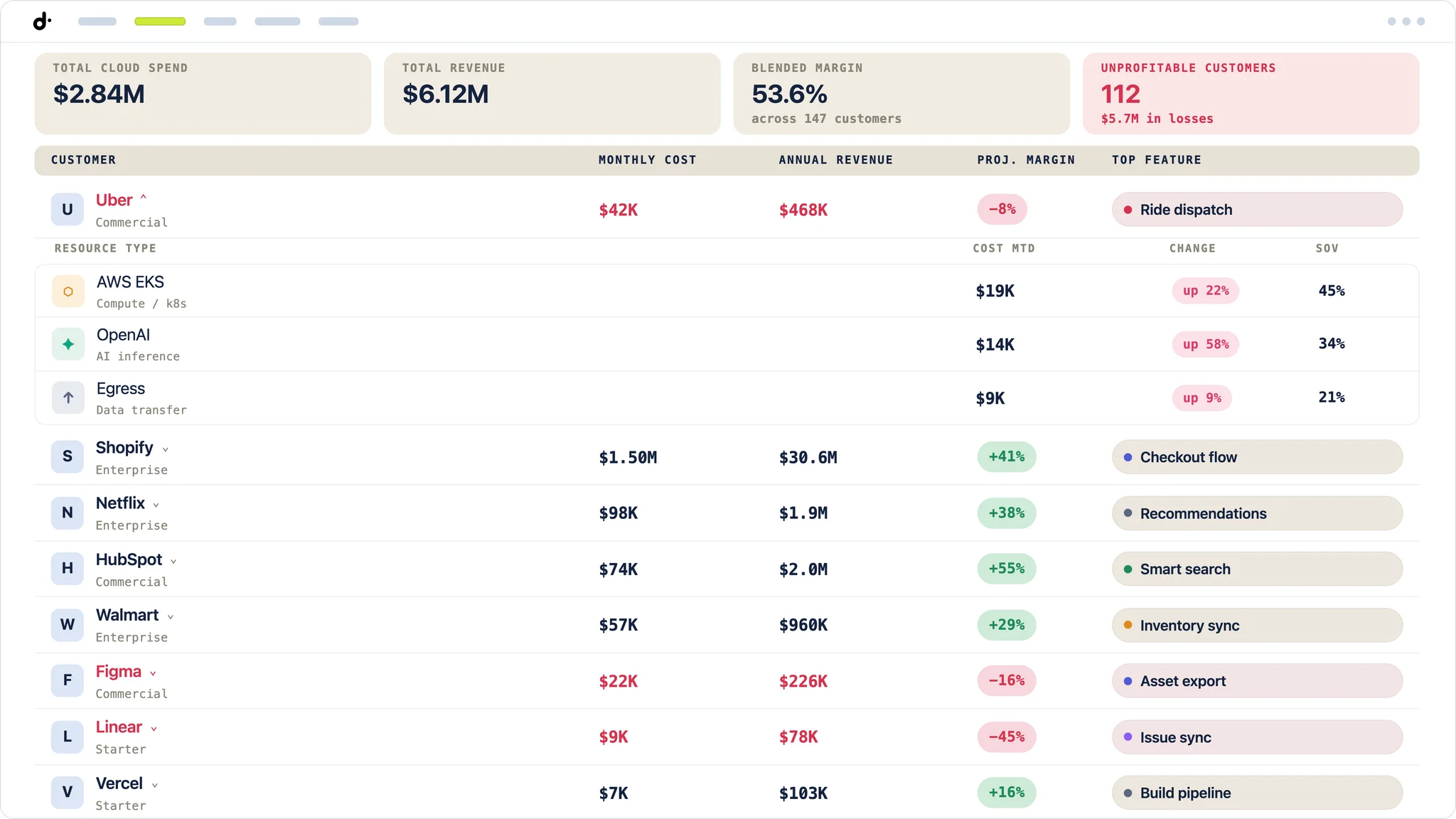






every customer. automatically.
Know Your Customer COGS
Attribute observes customer behavior at runtime and attributes cost based on actual resource usage and consumption.
- Full customer cost breakdown
- Automatic COGS and margin based on true customer usage.
- Identify blind spots like k8s, AI, network, and NAT.
- Full break down of “shared resources” without manual work.
- Works natively in multi-tenant architectures
you can't just "tag" a customer
How It Works
Attribute’s eBPF and Deep Packet Inspection (DPI) tech allows us to scan and identify customers’ identifiers from the traffic and correlate cloud consumption in runtime.
- eBPF-based data extraction.
- Automatically identify costs from real-time usage.
- Runtime cost distribution across all customer accounts.
- No change in code or configuration
See how modern companies become healthier with Attribute™
Meet Island - the enterprise AI platform
Gaining True Cost-Per-Customer Visibility, Without Tagging
for every customer
See the cost per feature
- Full feature usage breakdown by customer.
- Cost per feature per customer.
- Identify low-margin-high-usage features.
- Data driven pricing and tier structure decisions.
- Churn indicators and customer behaviors
Ready to scale without losing margin?
Know your true cost-to-serve before you price it, sell it, or scale it.
immediate business impact
Improve your margins
Identify underpriced enterprise accounts
Surface accounts where cloud cost outpaces contract value before renewal.
Terminate or reprice unprofitable customers
Know exactly which customers cost more than they pay and by how much.
Focus go-to-market on your most profitable segments
Rank segments by gross margin, not just revenue to guide sales and marketing.
Refactor or limit high-cost AI features killing your margin
Pinpoint which AI workloads are disproportionately expensive per customer.
Separate Free tier costs from COGS automatically
Track acquisition cost vs. revenue cost
what you get
Attribute™ sees what your tools miss
LLM gateways, shared GPU clusters, and AI agents don't have tags. They never will. Instead, we read runtime network traffic directly, identifying which model was called, by which workload, triggered by which customer or agent.
Token-in, token-out
Input, output, and cached tokens broken out per request.
Allocate AI cost per feature
See which product features drive LLM spend.
Per-agent cost
Measure what each AI agent costs to run.
AI anomalies. In real-time.
Catch unexpected token spikes before they hit margins.
AI usage per customer, human vs. non-human
Separate human spend from agent and know what each customer actually costs to serve.
Signals → actions
Pause keys or swap models when usage crosses policy.

visibility
AI allocated
code changes
Watch on-demand
Recordings of our most recent webinars. Register once to unlock the library.



You're getting billed for AI. You just can't explain it. Not by team, not by feature, not by customer. The line item grows every month and the breakdown stays a mystery. This session is about why that keeps happening - and what it actually takes to fix it.
Hosted by Amit Kinha, DoiT's resident AI FinOps practitioner, this session is built for the people actually dealing with the problem - not a sales pitch, just a straight look at what's broken and what works.
Library
Enterprise-grade by default
Read-only access, audited controls, and the certifications procurement teams ask for.
SOC 2/3
GDPR
ISO 27001
Ready to scale without losing margin?
Know your true cost-to-serve before you price it, sell it, or scale it.


available on
Attribute on Cloud Marketplaces
Through Marketplaces, customers benefit from faster onboarding, reduced procurement overhead, and the ability to align Attribute™ spend with their existing AWS PPA, with full compliance under updated marketplace guidelines.



Frequently asked
questions
Why can't I use tags to track cost per customer?
Tags track infrastructure, not the customers using it. A customer moves through your platform hitting your API, consuming shared resources, triggering inference calls without leaving any tag behind. In multi-tenant architectures, there is no resource to tag. You need visibility at the traffic layer, not the infrastructure metadata layer, to see what each customer actually costs.
How does Attribute identify which customer is consuming which resources?
Attribute's eBPF sensor uses deep packet inspection to read customer identifiers such as JWT tokens, HTTP headers, or client IDs directly from the traffic. It correlates those identifiers with the infrastructure resources consumed in real time, attributing compute, network, database, and AI spend to the correct customer without any changes to your application code.
How do I find out which customers are unprofitable?
Attribute surfaces cost-to-serve per customer alongside your revenue data, flagging accounts where infrastructure costs exceed what the customer pays. One Attribute customer discovered over 360 accounts where COGS exceeded revenue, totaling more than $1.3 million in losses that were completely invisible before.