
Cloud Intelligence™
Why We’re Launching Attribute™
This page is also available in Deutsch, Español, Français, Italiano, 日本語, and Português.


About Vadim Solovey
CEO
Founded DoiT in 2011 and have been here ever since — in every flavor of CTO, co-CEO, and now CEO. I started my career in 1999 building data centers before anyone called it "the cloud," and I've spent the two decades since trying to deliver on what the cloud was actually supposed to be. I still write code most weeks.
My personal pageYou can see your AI bill. You can even somewhat explain it. But, you can’t attribute that spend to your customers, teams or users. As a result, you can’t say if you’re pricing your products with healthy margins. That gap - between what you’re spending and what you can account for - is the problem we’re solving with Attribute™.
The cloud cost attribution has never been easy, especially for shared resources. We’ve spent fifteen years helping 4000+ customers untangle shared infrastructure, enforce tagging policy, and build chargeback models that hold up under scrutiny. It’s always been a difficult problem. AI has made it even harder.
The infrastructure AI runs on was built for speed and scale, not attribution. The attribution approaches the industry settled for in cloud (tags) don’t transfer. It’s an architectural reality - and it required a different kind of answer.
The instrumentation trap
The standard answer to cost attribution has always been instrumentation. Tag your resources. Wrap your API calls in an SDK. Enforce naming standards. Build a pipeline that aggregates those signals into a dashboard.
For traditional cloud infrastructure, this approach works, even though not perfectly. The underlying shared infrastructure is relatively static. The ownership model is relatively clear. You can get to “good enough”, if you make a few concessions.
AI infrastructure breaks every assumption that approach is built on.
A single managed model serves multiple customers simultaneously. A shared GPU cluster runs models for multiple products at once. An LLM gateway aggregates requests from agents, harnesses, and humans into a single outbound stream. Not to mention an agentic workload can spawn sub-agents that trigger infrastructure costs with no visible relationship to the AI bill line item that originated them.
There’s no SDK you can wrap around a shared GPU. There’s no tag that survives the hop through an LLM proxy. And AI workloads don’t move at a pace that instrumentation can keep up with. An agent can spawn a thousand sub-agents overnight. By the time you’ve wrapped the new call patterns in an SDK and pushed the update, the bill has already landed.
The attribution gap in AI spend isn’t a process problem you can instrument your way out of. It’s an architectural reality of how AI infrastructure works.
“The attribution gap in AI spend isn’t a process problem you can instrument your way out of. It’s an architectural reality of how AI infrastructure works.”
That’s the insight that led us to Attribute™. If the architecture of AI workloads defeats instrumentation by design, then instrumentation is the wrong answer. You need to measure from a layer that sees everything - before any abstraction, before any proxy, before any ownership boundary. You need to measure at the O/S kernel.
A different approach
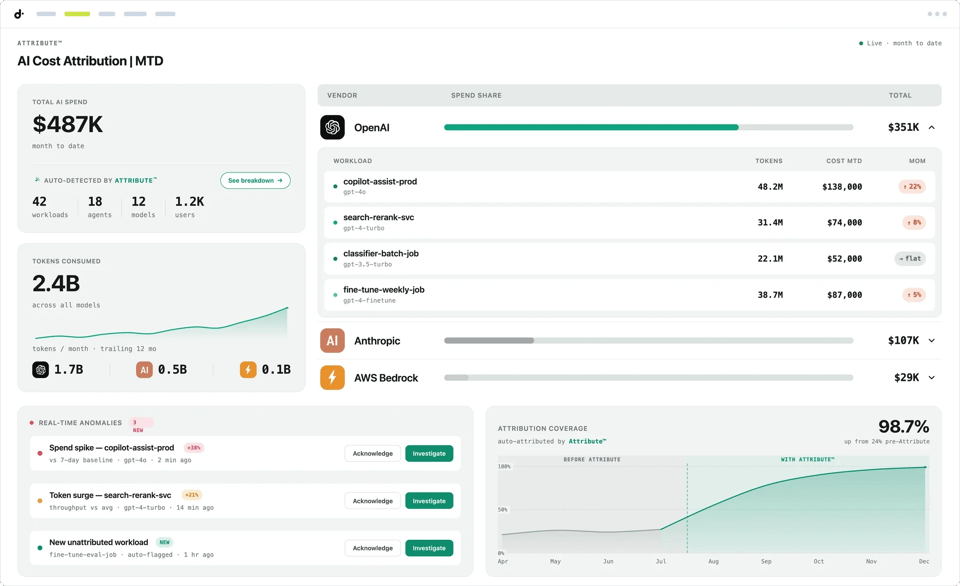
Attribute™ deploys an eBPF sensor that operates inside the operating system. It observes actual consumption - every token, every model request, every GPU cycle - as it happens, and maps each unit back to the process, container, pod, and request responsible. It then joins that data with provider billing from Anthropic, OpenAI, Google Gemini, and AWS Bedrock, splitting cached tokens, reasoning tokens, input tokens, and output tokens automatically.
The result is per-customer, per-feature, per-agent token economics: produced continuously, without instrumentation, without tagging, without code changes.
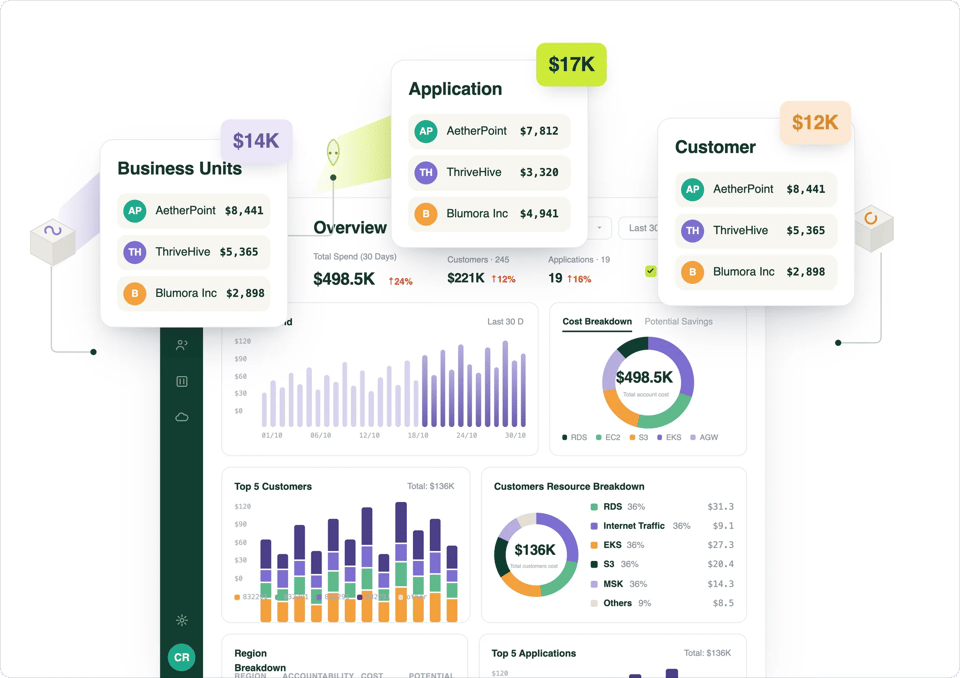
The tools that exist today (and there are decent ones) fall into two camps: 1. Those that ask engineers to define allocation logic in code, and 2. Those that use metadata inference to propose virtual tags automatically.
Both are meaningful improvements on manual tagging. But neither can see inside a shared GPU. Neither can follow a token through an LLM gateway back to the customer or user that originated it. The blocker isn’t the tool. It’s the method.
Any approach that depends on metadata to reconstruct attribution will hit the same wall, because the metadata doesn’t exist at the layer where the consumption actually occurs.
Kernel-level measurement isn’t a technical detail. It’s the only architecture that produces complete attribution across the full surface area of modern AI infrastructure.
Cloud bill shouldn't be a mystery
One platform for AI and Cloud optimization.
Why Tokenomics is the right frame
With this new approach, we’re actively helping build the category of Tokenomics, and that’s something specific. It’s not AI cost management - the industry is full of that conversation, and most of it is just cloud FinOps vocabulary applied to a new line item.
Tokenomics is the discipline of understanding what each token is actually worth to your business: who consumed it, what it produced, and whether the spend was justified by the outcome.
That requires attribution at the token level. Not account-level. Not team-level. Token-level. You need to know that a specific customer session consumed 47,000 tokens across three models, that 31,000 of those were in a feature that drives 80% of renewal likelihood, and that the remaining 16,000 were in an experimental feature that hasn’t shipped to production yet. That’s the data that lets you make intelligent decisions about where to invest and where to pull back.
You can’t get to that data through tagging. You can’t get to it through SDKs. You can only get to it if you’re measuring at the layer where the actual consumption occurs.
The Linux Foundation recently announced the intent to launch the Tokenomics Foundation, in partnership with the FinOps Foundation, to establish open industry standards for AI token economics. JR Storment, Executive Director of the FinOps Foundation and a close DoiT partner, put it plainly: naming the problem isn’t solving it.
That’s exactly right. The category now has a name and an institutional home. Attribute™ is the measurement layer that makes it operational.
Why DoiT, and why now?
DoiT has managed more than $20 billion in cloud spend for 4,500 customers across 27 countries. We’ve watched every major cloud cost category emerge: compute optimization, commitment management, Kubernetes cost allocation. The teams that establish the right measurement foundation early make every subsequent decision better. The teams that defer attribution until the bills are already large spend years reconstructing context they could’ve had from day one.
AI spend is moving faster than any previous category. Our own research - a survey of 500 finance leaders - found that 79% of enterprises have already experienced AI cost overruns, and only 15% say they can accurately calculate AI ROI without significant bottlenecks. The window to establish the right toolset is now, not after the next surprise bill.
There’s a second signal worth naming. As AI moves from experimentation to production infrastructure, the questions change. It’s no longer “what are we spending” - it’s “what does it cost to serve each customer,” “which AI features are compressing our margins,” and “which agents are consuming spend with nothing to show for it.” Your board is asking these questions. Your CFO is asking them. Account-level spend data produces account-level answers. Kernel-level attribution - per customer, per agent, per feature - produces the kind of answers that actually change decisions.
That’s why we built this. And that’s why we’re bringing it to DoiT now.
About Attribute™
Fifteen minutes to install. No instrumentation required. Token economics by end of day. If you want to see what Attribute™ looks like in your own environment, book a demo here.


