
Attribute AI without
Attribute Every AI Token to the Customer, Feature, and Agent Behind It
AI spend is a black box. LLM Gateways show token totals but can’t tell you who burned them. Attribute™ traces every token, inference, and training run back to the team, product, and customer that drove it. True AI TCO, across every provider.
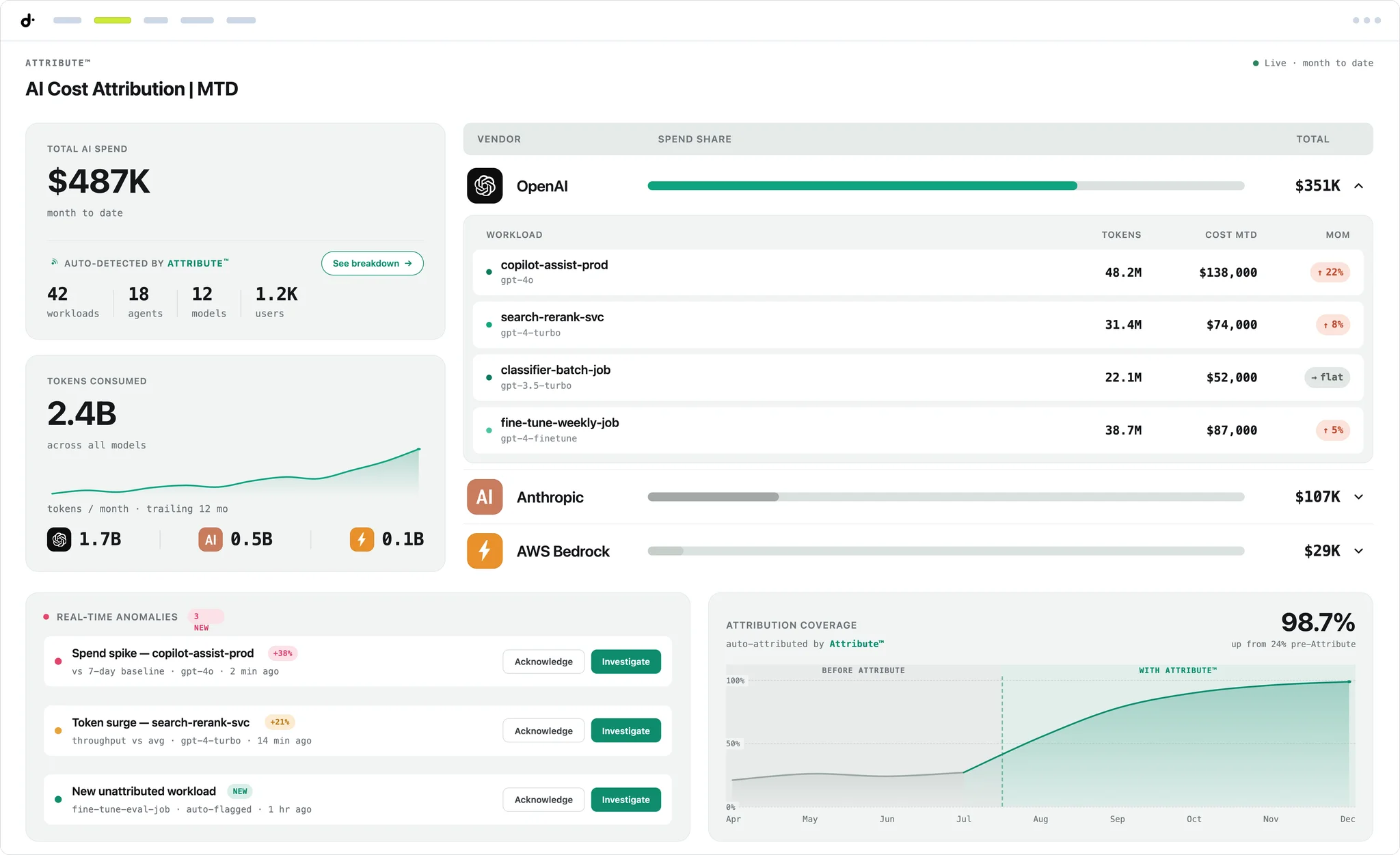






every token, allocated.
AI Consumption Insights
- Track token consumption at the application level.
- Usage based AI cost allocation broken down by customer.
- Complete TCO: tokens, compute, GPUs, and databases.
see past the gateway
Gateways Shouldn't Hide Your Costs
Most teams route AI through gateways. The problem is that every billing tool sees the gateway as the consumer.
Attribute™ eBPF sensor sees traffic into/out of the gateway, tracing each inference call back to the workload, product, and customer that triggered it.
There’s no instrumentation required. Works with managed and self-hosted gateways, across OpenAI, Azure OpenAI, Bedrock, and Anthropic.
See how modern companies become healthier with Attribute™
Meet Island - the enterprise AI platform
Gaining True Cost-Per-Customer Visibility, Without Tagging
sort the humans from the agents
Human vs. Non-Human AI Cost
Automation platforms are making API calls to your products around the clock, often under the same billing as your human users.
Attribute™ separates human traffic from non-human traffic at runtime, so you can see exactly what AI agents, bots, and integrations are costing you versus real users.
- Scale based on how humans and AI agents actually consume.
- Identify agents driving your infrastructure costs.
- Price tiers based on actual consumption patterns.
- Catch runaway agents before it hits your margins.
margin starts with attribution
Track AI Usage Per Customer
AI cost is dynamic and usage-based. Without context, it’s impossible to design pricing, forecast margins, or scale responsibly. Attribute ties AI spend to consumption, so every pricing and scaling decision is backed by actual usage data.
- AI token consumption surfaced in customer context.
- Per-feature AI cost visibility across your product architecture.
- Margin impact measured per AI capability, not just per model.
- Early detection of runaway consumption before it hits the P&L.
AI Attribution in Action
So, how does it work?
Other FinOps tools read your billing exports. Cloud Intelligence™ reads runtime data and maps costs to the workload that spent it. Instantly attribute AI spend to customers, workloads and teams.
what you get
Attribute™ sees what your tools miss
LLM gateways, shared GPU clusters, and AI agents don't have tags. They never will. Instead, we read runtime network traffic directly, identifying which model was called, by which workload, triggered by which customer or agent.
Token-in, token-out
Input, output, and cached tokens broken out per request.
Allocate AI cost per feature
See which product features drive LLM spend.
Per-agent cost
Measure what each AI agent costs to run.
AI anomalies. In real-time.
Catch unexpected token spikes before they hit margins.
AI usage per customer, human vs. non-human
Separate human spend from agent and know what each customer actually costs to serve.
Signals → actions
Pause keys or swap models when usage crosses policy.
Ready to scale AI without losing margin?
Know your true AI cost-to-serve before you price it, sell it, or scale it.
come with the platform. not the invoice.
What are Forward Deployed Engineers?
AI spend moves fast and hides well. You see the bill. You can't see which model, team, or feature drove it. Forward Deployed Engineers close that gap.
They customize Attribute™ in your environment and wire attribution into your workflows.
They know your architecture, your constraints, and your goals. They turn raw usage data into decisions you can act on.

visibility
AI allocated
code changes
Watch on-demand
Recordings of our most recent webinars. Register once to unlock the library.



You're getting billed for AI. You just can't explain it. Not by team, not by feature, not by customer. The line item grows every month and the breakdown stays a mystery. This session is about why that keeps happening - and what it actually takes to fix it.
Hosted by Amit Kinha, DoiT's resident AI FinOps practitioner, this session is built for the people actually dealing with the problem - not a sales pitch, just a straight look at what's broken and what works.
Library
Enterprise-grade by default
Read-only access, audited controls, and the certifications procurement teams ask for.
SOC 2/3
GDPR
ISO 27001
Ready to scale AI without losing margin?
Know your true AI cost-to-serve before you price it, sell it, or scale it.


available on
Attribute on Cloud Marketplaces
Through Marketplaces, customers benefit from faster onboarding, reduced procurement overhead, and the ability to align Attribute™ spend with their existing AWS PPA, with full compliance under updated marketplace guidelines.



Frequently asked
questions
Why can't my existing FinOps tool show me AI costs by customer or feature?
Most FinOps tools rely on billing exports and tags. AI infrastructure, LLM gateways, shared GPU clusters, inference endpoints have no tagging surface. Every call looks the same at the billing layer. Without runtime visibility into the traffic itself, there's no way to separate which customer or workload triggered each request.
How does Attribute™ attribute AI costs?
Attribute™ deploys a lightweight eBPF sensor that reads network traffic at runtime. It identifies which workload made each inference call, which customer or feature triggered it, and maps the cost back accordingly. It works with managed and self-hosted LLM gateways across OpenAI, Anthropic, Bedrock, Azure OpenAI, and Google Vertex AI.
What is the difference between human and non-human AI traffic, and why does it matter?
Human traffic comes from real users interacting with your product. Non-human traffic comes from automation platforms, AI agents, bots, and integrations making API calls in the background. Without separating them, you can't accurately price AI tiers, forecast usage, or catch a runaway automation before it hits your margins. Attribute™ identifies both at runtime without requiring separate API keys.
How do I know which AI features are profitable?
Profitability per AI feature requires knowing the true cost to run it, tokens, compute, GPU hours, and the databases behind it mapped to the revenue or value it generates. Attribute™ surfaces the full AI workload TCO per feature based on runtime consumption, giving pricing and product teams the data to make those calls with actual numbers instead of estimates.
Does Attribute™ work with LLM gateways like LiteLLM?
Yes. Attribute™ eBPF sensor reads traffic into and out of your LLM gateway, tracing each inference call back to the workload, product, or customer that triggered it regardless of whether the gateway is managed or self-hosted. This resolves the most common AI cost blind spot: the gateway shows total spend, but hides who caused it.
How long does it take to see AI cost attribution after deploying Attribute?
Most customers see attributed AI cost data within the same day. Deployment requires a 15-minute sensor install, attribution begins as soon as the sensor observes traffic.
Integrated with your entire tech-stack
Works natively with your cloud providers, data platforms, DevOps and SecOps tooling. Custom integrations are available on request.
Explore