
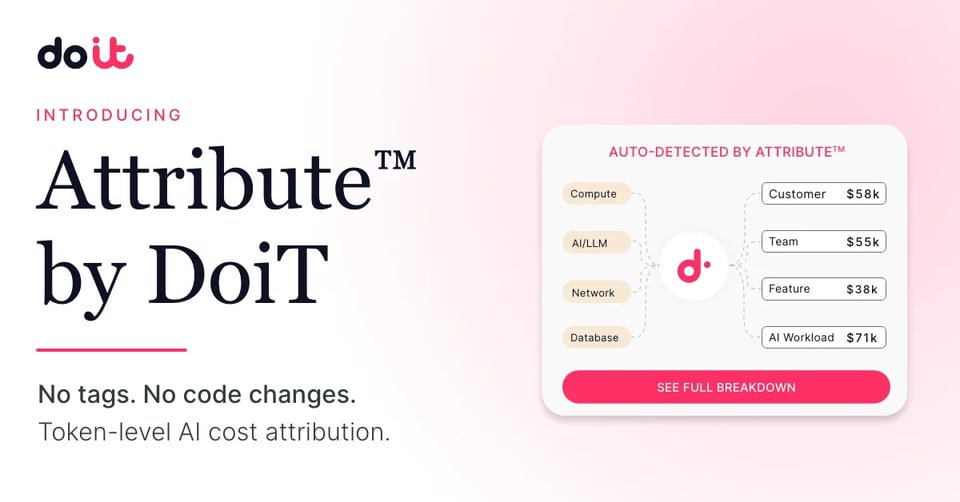
Attribute™ measures real-time consumption at the kernel and traces every token, model request, and GPU cycle to the customer, feature, and agent that drove it
SANTA CLARA, Calif., July 7, 2026 – DoiT, the company behind Cloud Intelligence™, today introduced Attribute™, a technology that attributes AI spend across tokens, model requests, and GPU usage with zero instrumentation. Now generally available, Attribute™ requires no SDK, no tagging policy, and no code changes. A lightweight eBPF sensor installs in about 15 minutes and starts producing per-customer, per-feature, and per-agent token economics the same day.
The pressure behind this is measurable. DoiT's internal customer data projects monthly AI spend will triple in the next 12 months. Yet in a recent survey of 500 leaders at large enterprises, only 15 percent said they could calculate AI ROI without significant bottlenecks, and the average cost overrun was extremely close to the tolerance breaking point. Spending is climbing, returns are getting harder to prove, and crucially, no one can see where the money is actually being spent.
Until now, attributing AI spend meant instrumenting it. Engineering teams wrapped every model call in an SDK, threaded metadata through every request, or enforced tagging standards that shared GPUs and single-account model APIs were defeated by design. An API key or tag cannot split a GPU running many models at once, and an SDK only sees the calls someone remembered to wrap. The work falls on engineers, the coverage is always partial, and the numbers drift from reality.
Attribute™ takes the opposite approach: it measures what actually runs. The sensor observes real consumption inside the operating system kernel and maps every unit of GPU, CPU, API call, memory, network, and I/O back to the process, container, pod, and request responsible. It also identifies each outbound call to a managed model API and joins it with provider cost data, so token spend on Anthropic, OpenAI, Google Gemini, and AWS Bedrock lands on the workload, tenant, and agent that drove it rather than on a shared account no one can break down. Cached, reasoning, input, and output tokens are split automatically. The result is token economics that holds up to audit: cost per token, per request, per session, per customer, and per agent, with no engineering effort to produce or maintain it.
The same measurement extends beyond AI. Kubernetes clusters, multi-tenant databases, storage buckets, and networking are attributed the same way, so the cost of any shared resource lands on the workload that caused it. Teams see the cost to serve each customer, the gross margin on each account, and the unit economics of each AI feature, generated automatically and continuously.
"For fifteen years the industry treated cost attribution as an instrumentation problem: tag it, wrap it, label it, and hope coverage holds. Tokens are the atomic units of AI, and you can't tag your way to the truth inside a shared GPU or a single Bedrock account. Attribute measures what actually ran and what actually called, at the kernel, with nothing to instrument. Fifteen minutes to install."
— Izhak Zimmermann, General Manager of Attribute
If you want to see Attribute in your own environment, book a demo.
About DoiT
DoiT keeps your cloud infrastructure always at its best. The Cloud Intelligence™ platform combines AI-driven FinOps automation with Forward Deployed Engineers who work alongside customer teams to ship real savings, not just recommendations. Across AWS, Google Cloud and Azure, DoiT manages more than $20 billion in cloud spend for 4,500 customers in 27 countries, with a 99.7% average customer satisfaction score. The platform covers AI tokenomics, Kubernetes, commitment management, data platform optimization and FinOps automation. To learn more, visit doit.com.
Cloud bill shouldn't be a mystery
One platform for AI and Cloud optimization.


