
Cloud Intelligence™
10 Questions to Ask a Cloud Financial Management Vendor
Ten specific questions to ask any cloud financial management vendor, built from Gartner's own evaluation criteria, before you sign anything.
This page is also available in Deutsch, Español, Français, Italiano, 日本語, and Português.


About Josh Palmer
I'm Josh Palmer, Head of Content at DoiT, where I split my time across multiple business units including DoiT Cloud Intelligence, PerfectScale (Kubernetes cost optimization), and SELECT (Snowflake, Databricks, and BigQuery cost optimization). Before DoiT, I spent four and a half years at OnBoard building content for a board intelligence platform used by 6,000+ organizations, and before that, two years as Content Marketing Manager at Zylo, a SaaS management platform.
My personal pageTL;DR: Every cloud financial management vendor's demo looks the same: clean dashboards, an AI-powered insights panel, a promise to cut your cloud bill. The 10 questions below cut through that and get at what Gartner's own evaluation criteria actually test for: whether a tool manages financial risk, forecasts accurately, increases efficiency, and increases accountability. Ask these questions in every vendor conversation, whether you're comparing established cloud cost management vendors or newer entrants, and you'll find out which of those four a tool actually does, versus which it just claims to.
Why a good demo doesn't tell you what you need to know
A vendor demo is built to show you the platform at its best: clean data, obvious wins, a curated set of workflows. That's a reasonable thing for a vendor to optimize for, and it's also exactly why a demo alone can't tell you how a tool performs on your actual environment, with your actual tagging gaps, your actual multi-cloud sprawl, your actual AI spend.
Gartner's Magic Quadrant for Cloud Financial Management Tools scores vendors against two things: Ability to Execute and Completeness of Vision. Underneath that, every CFM platform is supposed to do four specific jobs: manage financial risk, forecast spend accurately, increase efficiency, and increase accountability. That's a useful filter to bring into a vendor conversation, because it turns a features checklist into a set of questions a vendor either can or can't answer specifically.
The 10 questions below are organized around those four capabilities, plus the practical, contractual, and AI-specific questions that decide whether a tool that looks right on paper actually works for your environment.
The 10 questions to ask every CFM vendor
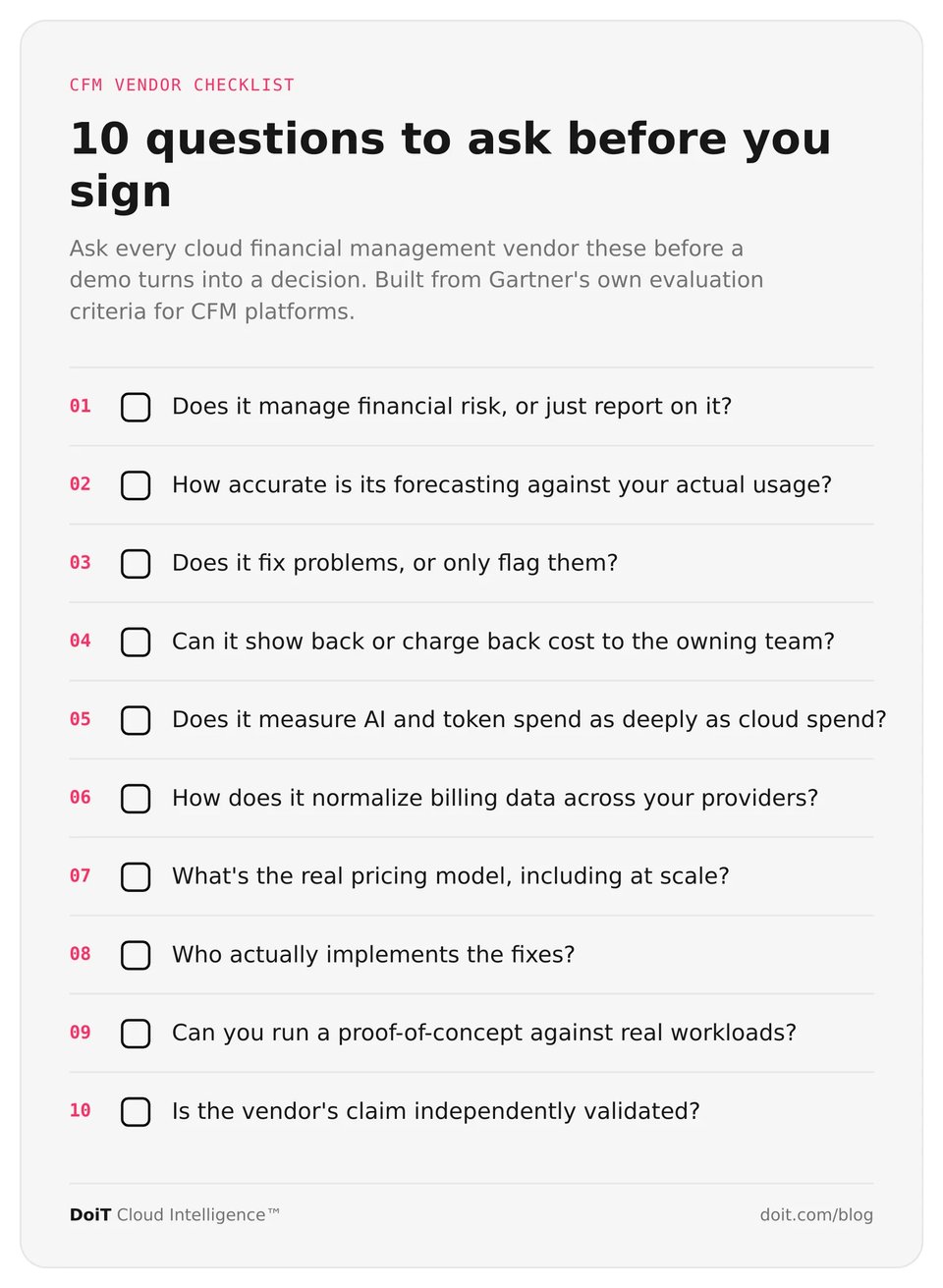
1. Does it manage financial risk, or just report on it?
Ask the vendor to walk through a specific anomaly detection scenario: a cost spike from a misconfigured autoscaling group, a forgotten dev environment left running, a sudden jump in a shared service's bill. Ask how long detection takes, whether it's automatic or requires someone to notice a chart, and what happens after detection: does the tool alert a human, or can it act.
Red flag: the answer is a dashboard screenshot with no mention of time-to-detection or what happens next.
2. How accurate is its forecasting against your actual usage, not a sample account?
Forecasting demos usually run on clean, idealized data. Ask instead how the tool handles forecasting when usage is genuinely volatile: a seasonal spike, a new product launch, a migration mid-quarter, and ask what data it needs from you to forecast well. A vendor that forecasts confidently off 30 days of your real usage is more useful than one that shows a smooth trend line off a demo account.
Red flag: forecasting accuracy claims with no mention of what input data or ramp-up time they require.
3. Does it fix problems, or only flag them?
This is the line between a reporting dashboard and an actual CFM platform. A tool can surface a rightsizing opportunity, an idle resource, an expiring commitment, but does anything happen next without a human manually implementing the fix? Ask specifically what's automated versus what generates a recommendation someone on your team has to act on, and ask what happens when a recommended fix could break something: does the tool respect exclusions and guardrails, or does automation mean all-or-nothing.
Red flag: "we surface recommendations" with no answer to "and then what."
4. Can it show back or charge back cost to the team that actually owns it?
Cost allocation is where a lot of tools quietly fall apart, particularly past the easy cases. Ask how the tool attributes cost when tagging is incomplete or inconsistent, which is the normal state of most real environments, not the exception. Ask specifically about shared services, a database used by six teams, a Kubernetes cluster running multiple workloads, and multi-tenant products where a resource serves many customers at once.
Red flag: the demo only shows allocation on cleanly tagged resources.
5. Does it measure AI and token spend at the same depth as cloud spend?
AI cost management is no longer a nice-to-have line item on this checklist. The FinOps Foundation's State of FinOps 2026 report found that 98% of FinOps teams now manage AI spend, up from just 31% two years ago, and a session at Gartner's own December 2026 conference already refers to the next edition of this Magic Quadrant as covering "Cloud and AI Financial Management Tools." Ask specifically how the tool attributes spend across model providers (Anthropic, OpenAI, Google Gemini, AWS Bedrock), whether it breaks down input, output, and cached tokens, and how it handles a request that passes through a shared LLM gateway serving multiple teams.
Red flag: "we support AI cost tracking" with no detail on token-level breakdown or multi-provider coverage.
6. How does it normalize billing data across your providers?
Multi-cloud billing data doesn't arrive in a consistent format. AWS, Azure, Google Cloud, and platforms like Databricks and Snowflake all structure usage and cost data differently, which is the exact problem the FinOps Foundation's FOCUS specification (FinOps Open Cost and Usage Specification) exists to solve. Ask whether the vendor supports FOCUS-formatted data, and if not, ask how they normalize cost data across providers so an hour of AWS compute and an hour of Azure compute are actually comparable in their reporting.
Red flag: no familiarity with FOCUS, or a normalization method that only covers one or two providers well.
7. What's the real pricing model, including at scale?
Pricing models in this market vary more than buyers expect: flat SaaS fees, percentage-of-managed-spend, tiered plans that unlock features at higher spend levels. Ask directly what the model is, what happens to your bill as your cloud spend grows, and whether optimization work that shrinks your cloud bill also shrinks what you pay the vendor, or whether a percentage-of-spend model quietly reduces the vendor's incentive to help you cut costs. Ask if there's a savings guarantee, and if so, exactly what it guarantees.
Red flag: vague answers about pricing until late in the sales process, or a pricing model that isn't affected at all by whether the tool actually saves you money.
8. Who actually implements the fixes?
Some vendors sell pure software: you get the dashboard and the recommendations, and your team does the rest. Others include implementation help, whether that's professional services, a customer success function, or dedicated engineers who work inside your environment. Ask specifically who writes the Terraform change, who negotiates the reserved instance purchase, who handles the edge case the automation didn't anticipate. For a lean team, that answer can matter more than any feature on the list.
Red flag: "our customer success team will help you get set up" as the entire answer to an implementation question.
9. Can you run a proof-of-concept against real workloads, not a sandbox?
A proof-of-concept against your actual environment, actual tagging gaps and all, tells you more than any demo. Ask what a POC looks like in practice: how long it takes, what access it requires, and whether the results you see in a POC are representative of what you'd get in production, or whether the POC gets extra hand-holding that a live account wouldn't.
Red flag: reluctance to run a POC against a real, even if limited, slice of your actual infrastructure.
10. Is the vendor's claim independently validated?
Marketing copy calls almost every vendor in this space "AI-powered," "enterprise-grade," and "the leader in FinOps." Independent validation cuts through that: Gartner's Magic Quadrant placement, the FinOps Foundation's FinOps Certified Platform designation, SOC 2 or ISO 27001 certification, and reference customers you can actually talk to, ideally ones running a similar cloud footprint to yours. Ask for all four, and be specific about wanting a reference call, not just a case study.
Red flag: certifications or placements mentioned only in the abstract, with no willingness to connect you to a reference customer.
Quick-reference checklist
| # | Question | Maps to |
|---|---|---|
| 1 | Does it manage financial risk, or just report on it? | Managing financial risk |
| 2 | How accurate is its forecasting against your actual usage? | Forecasting and estimation |
| 3 | Does it fix problems, or only flag them? | Increasing efficiency |
| 4 | Can it show back or charge back cost to the owning team? | Increasing accountability |
| 5 | Does it measure AI and token spend at the same depth as cloud spend? | AI/LLM cost coverage |
| 6 | How does it normalize billing data across your providers? | Data foundation (FOCUS) |
| 7 | What's the real pricing model, including at scale? | Commercial fit |
| 8 | Who actually implements the fixes? | Implementation model |
| 9 | Can you run a proof-of-concept against real workloads? | Validation before you buy |
| 10 | Is the vendor's claim independently validated? | Third-party proof |
Cloud bill shouldn't be a mystery
One platform for AI and Cloud optimization.
How to use this checklist against specific vendors
If you're down to a short list, DoiT's cloud cost management tools buyer's guide profiles how the leading cloud cost management vendors stack up against Gartner's own evaluation dimensions, tool by tool. For a direct, head-to-head read on specific matchups, DoiT publishes comparison pages against Vantage, Cloudability, Flexera, and CloudZero that walk through where each platform's approach diverges on execution, not just feature lists.
Whichever vendors end up on your short list, the 10 questions above travel with you. A vendor that answers all 10 specifically, with real numbers and named capabilities rather than marketing language, has earned a proof-of-concept. One that answers in generalities has told you something too.
Frequently asked questions
What questions should I ask a cloud financial management vendor?
Ask how the tool detects and responds to cost anomalies, how accurately it forecasts against your real usage, whether it automates fixes or only flags them, how it allocates cost when tagging is incomplete, how it handles AI and token spend, how it normalizes billing data across providers, what the actual pricing model is at scale, who implements fixes, whether you can run a proof-of-concept on real workloads, and whether its claims are independently validated.
What's the difference between a vendor RFP and a proof-of-concept?
An RFP (request for proposal) collects written answers from multiple vendors on paper, which is useful for narrowing a list but easy for a vendor to answer in generalities. A proof-of-concept runs the actual tool against a slice of your real environment, which surfaces gaps an RFP response can paper over: tagging problems, provider coverage gaps, allocation edge cases. Use an RFP to narrow to two or three vendors, then use a POC to make the final call.
How do I evaluate a CFM vendor's AI cost management claims specifically?
Ask for token-level detail (input, output, cached, and reasoning tokens), ask which model providers are supported natively versus through generic integrations, and ask specifically how the tool handles spend that passes through a shared LLM gateway or an agentic workload that spawns its own sub-costs. A vendor that can only point to a single-provider dashboard hasn't solved the multi-provider reality most enterprises actually run.
Should pricing model be a dealbreaker when choosing a CFM vendor?
Not a dealbreaker on its own, but it's worth understanding fully before you sign. A percentage-of-managed-spend model can misalign incentives if the vendor's fee doesn't shrink alongside your optimized bill. A flat SaaS fee avoids that but doesn't scale down if your usage drops. Ask how the model behaves in both directions, spend going up and spend going down, before comparing sticker price alone.
What certifications or validations actually matter when evaluating a CFM vendor?
Gartner's Magic Quadrant placement and the FinOps Foundation's FinOps Certified Platform designation are the two most relevant industry-specific validations in this market. SOC 2 and ISO 27001 matter for security and compliance review, particularly at enterprise scale. None of these substitute for talking to a reference customer running a comparable environment to yours.


