
Cloud Intelligence™
Best Cloud Cost Management Tools: A Buyer's Guide for 2026
Compare the cloud cost management tools buyers shortlist most in 2026 against Gartner's own evaluation criteria, with pricing models, pros, and limitations for each
This page is also available in Deutsch, Español, Français, Italiano, 日本語, and Português.


About Josh Palmer
I'm Josh Palmer, Head of Content at DoiT, where I split my time across multiple business units including DoiT Cloud Intelligence, PerfectScale (Kubernetes cost optimization), and SELECT (Snowflake, Databricks, and BigQuery cost optimization). Before DoiT, I spent four and a half years at OnBoard building content for a board intelligence platform used by 6,000+ organizations, and before that, two years as Content Marketing Manager at Zylo, a SaaS management platform.
My personal pageTL;DR: Cloud cost management now spans four distinct jobs, visibility, allocation, automation, and governance, and no single vendor owns all four equally well. Gartner's own evaluation criteria cut through the marketing noise: a real cloud financial management (CFM) tool manages financial risk, forecasts spend, increases efficiency, and increases accountability. This guide rates the tools buyers shortlist most against those four criteria, profiles the seven worth a deep evaluation with pros, cons, and ideal use cases, and ranks 20 platforms across the broader landscape so you know which category you actually need before you sit through a single demo.
Every cloud cost management vendor's homepage reads about the same: real-time visibility, AI-driven recommendations, savings you can bank on. That sameness is the actual problem. Two tools can each check the box for "anomaly detection" and mean completely different things by it. One emails an alert three days after the spike lands on an invoice. The other routes it to the team that owns the spend within minutes, with the root cause already attached.
Gartner's Magic Quadrant for Cloud Financial Management Tools exists to cut through that ambiguity. It scores vendors against a defined set of mandatory capabilities instead of marketing copy. We covered the full methodology in our Gartner Magic Quadrant explainer, but the short version matters here: a genuine CFM platform manages financial risk, forecasts spend accurately, increases efficiency, and increases accountability. Not one or two of those. All four.
This guide applies that same lens across a wider field than most comparisons attempt. Eight platforms get a full evaluation with pros, cons, and the specific scenario each one fits. Thirteen more get a shorter, categorized look so you can see where they sit in the landscape before deciding whether they belong on your shortlist at all. If your evaluation is specific to a single cloud or workload type, two companion guides go deeper: 5 Best AWS FinOps Tools for 2026 and Best Kubernetes Cost Management Tools for CloudOps.
What Should a Cloud Cost Management Tool Actually Do?
Gartner's research defines four mandatory capabilities a tool needs before it counts as a true CFM platform rather than a reporting dashboard:
- Managing financial risk (catching anomalies and budget overruns before they become expensive surprises).
- Forecasting and estimation (predicting spend from historical patterns).
- Increasing efficiency (optimizing configuration, architecture, and contracts).
- Increasing accountability (showback and chargeback that connects spend back to the teams responsible for it).
The tools in this guide approach those four capabilities differently, and that difference is the real story, not the feature list. Some build governance and remediation directly into the platform, so a detected problem becomes a fixed problem without a ticket in between. Others start from asset and configuration data and work backward into cost, which changes how well they handle messy or inconsistent tagging. Matching the approach to where your team's actual gap sits, not just to whichever demo looked best, is what makes an evaluation worth the time it takes.
How the Leading Tools Stack Up Against Gartner's Four Capabilities
The table below is our own qualitative read of each platform's public feature set against Gartner's four mandatory capabilities, not an official Gartner score or ranking. Use it as a starting filter, then verify each rating against your own proof-of-concept.
| Tool | Managing financial risk | Forecasting & estimation | Increasing efficiency | Increasing accountability |
|---|---|---|---|---|
| DoiT Cloud Intelligence | Strong | Strong | Strong | Strong |
| CloudZero | Moderate | Moderate | Moderate | Strong |
| Vantage | Moderate | Strong | Moderate | Moderate |
| Harness Cloud & AI Cost Management | Strong | Moderate | Strong | Moderate |
| CAST AI | Limited | Limited | Strong | Limited |
| PerfectScale for Kubernetes | Moderate | Moderate | Strong | Moderate |
| Cloudaware | Moderate | Limited | Moderate | Strong |
| Cloudability by IBM | Moderate | Strong | Moderate | Strong |
Read across, not just down: a "Limited" rating usually means the tool is deliberately scoped to one layer of the problem (CAST AI, for instance, trades broad financial reporting for deep Kubernetes infrastructure automation) rather than a weakness to hold against it. The rating only matters relative to what you actually need.
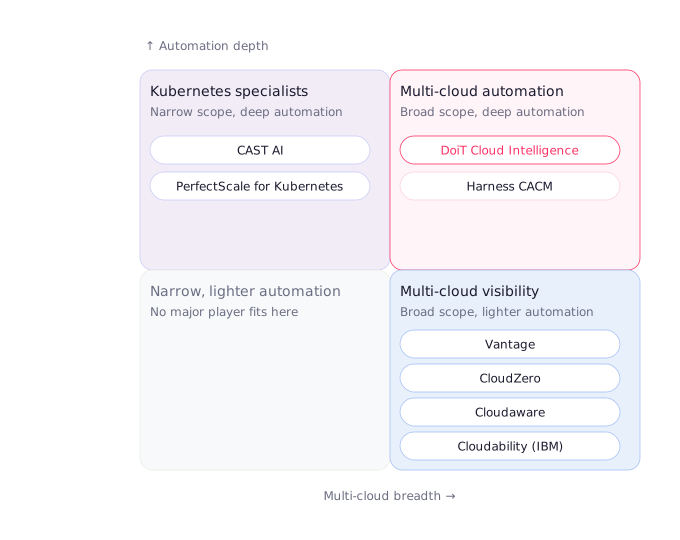
The Best Cloud Cost Management Tools to Evaluate in 2026
This isn't an exhaustive vendor list, that comes later in this guide. These are the eight platforms buyers consistently shortlist for general, multi-cloud cost management, based on current search and review activity on Gartner Peer Insights and G2. Each one gets a full look: what it's built to solve, where it holds up, where it doesn't, and who it's actually right for.
1. DoiT Cloud Intelligence
DoiT Cloud Intelligence combines cost analytics, governance, and optimization with direct access to a team of cloud architects. This Forward Deployed Engineer (FDE) model that separates DoiT from software-only platforms on this list. Every other tool here sells software. DoiT pairs the platform with people who implement the harder fixes: architecture changes, commitment strategy, and cross-cloud allocation logic that a dashboard alone can't resolve.
The platform covers AWS, Google Cloud, and Microsoft Azure in one view, and extends into AI and agent spend through Attribute by DoiT, which traces token-level costs back to the customer, feature, or agent that generated them. DoiT holds Visionary placement in Gartner's 2025 Magic Quadrant for Cloud Financial Management Tools and FinOps Foundation certification, the highest level the foundation offers.
DoiT's platform extends well past general cost analytics, too. PerfectScale for Kubernetes (profiled separately below) rightsizes containers at the pod level. PerfectScale for Commitments automates AWS Savings Plans, AWS Database Savings Plans, and Google Cloud Committed Use Discounts with laddered purchasing and risk guardrails rather than a single upfront bet. PerfectScale for Data Platforms, built on the SELECT product DoiT acquired, brings the same visibility and automated rightsizing to Snowflake, Databricks, and BigQuery compute spend.
And for organizations buying cloud directly, DoiT also operates as an AWS, Google Cloud, and Azure reseller: customers can purchase cloud through DoiT at partner pricing, with procurement advisory on Enterprise Discount Programs (EDPs) and Private Pricing Agreements (PPAs), consolidated multi-cloud billing, and no additional lock-in versus buying direct.
Pros
- Unified cost analytics and anomaly detection across AWS, Google Cloud, and Azure
- PerfectScale for Commitments automates and ladders AWS and Google Cloud commitment purchases with configurable guardrails, rather than one large upfront bet
- CloudFlow automates rightsizing, tag enforcement, and remediation workflows
- Attribute traces AI and agent spend to the customer, feature, or team that generated it
- Forward Deployed Engineers implement fixes a dashboard alone can't resolve
- Reseller and procurement advisory (EDPs, PPAs, consolidated billing) available directly through DoiT for AWS, Google Cloud, and Azure purchases
Cons
- More to configure upfront than a single-purpose dashboard
- Pricing scales with managed cloud spend, so cost estimation is less fixed than a flat subscription
Ideal use case: Multi-cloud organizations that want optimization automation paired with expert advisory support, and teams whose AI or agent spend has grown large enough to need dedicated attribution.
2. CloudZero
CloudZero built its positioning around unit cost metrics, cost per customer, per feature, or per team, rather than raw spend by service. Its allocation approach is code-driven: it maps cost to engineering context using data from your codebase and infrastructure rather than relying entirely on tags, which helps teams whose tagging discipline is inconsistent.
Pros
- Allocates cost without requiring complete or consistent tagging
- Strong unit economics: cost per customer, product, feature, and team
- Machine learning-based anomaly detection
- Extends allocation to AI and LLM spend alongside cloud infrastructure
Cons
- No published fixed pricing; contracts run as a percentage of managed spend, roughly 1% around $1 million in annual spend, tapering to 0.6% to 0.7% at $10 million
- Stronger on allocation and unit economics than on hands-on remediation
Ideal use case: Product and engineering-led organizations that need to answer "what does this feature or customer actually cost us," more than teams looking for automated fixes.
3. Vantage
Vantage covers cost reporting, real-time spend tracking, forecasting, and budget alerts across AWS, Azure, Google Cloud, Kubernetes, and a growing list of AI providers, including OpenAI and Anthropic. Its FinOps Agent and Autopilot features aim at hands-free waste elimination and AWS Savings Plan management.
Pros
- Broad, fast integrations across AWS, Azure, GCP, Kubernetes, and AI providers
- FinOps Agent and Autopilot for automated waste elimination and Savings Plan management
- Virtual tagging allocates cost without requiring engineering-applied tags
- Free tier lowers time-to-value for smaller teams
Cons
- Governance and remediation depth is lighter than platforms built around enforcement
- Larger enterprises with complex multi-account structures report more setup work to get allocation fully accurate
Ideal use case: Engineering teams that want fast time-to-value on visibility and forecasting, including AI provider spend, without a heavy implementation lift.
4. Harness Cloud & AI Cost Management
Harness folds cost management into its broader DevOps platform, which means cost visibility shows up inside the CI/CD pipeline itself rather than in a separate tool teams have to remember to check. Its Cloud Asset Governance feature applies a governance-as-code model, real-time policy enforcement with auto-remediation.
Pros
- Cost visibility surfaced inside CI/CD pipelines before workloads deploy
- Governance-as-code with real-time policy enforcement and auto-remediation
- Extends cost tracking to AI providers, including Anthropic, OpenAI, AWS Bedrock, and Google Vertex
- Commitment and Kubernetes node scaling management built in
Cons
- Vendor-cited savings of 70% to 90% on specific compute workloads are a starting point for your own proof-of-concept, not a guaranteed outcome
- Less compelling for teams not already using Harness for CI/CD
Ideal use case: Engineering organizations already running Harness for delivery pipelines that want cost governance enforced earlier in the workflow, before spend happens rather than after.
5. CAST AI
CAST AI optimizes at the node and cluster infrastructure layer, replacing Kubernetes' native autoscaler with its own engine for instance selection, bin-packing, and spot orchestration.
Pros
- Automated node rightsizing, bin-packing, and spot instance orchestration
- Replaces the native Kubernetes autoscaler with a purpose-built scaling engine
- Fast, measurable compute savings on Kubernetes-heavy workloads
Cons
- Kubernetes-specific, not a general multi-service cloud cost platform
- Needs pairing with a broader tool for non-container spend
Ideal use case: Teams whose primary cloud waste sits at the Kubernetes infrastructure layer, specifically instance selection and spot utilization. We cover CAST AI's Kubernetes-specific strengths in more depth in our Kubernetes cost management tools guide.
6. PerfectScale for Kubernetes
Part of the same PerfectScale family as DoiT's Commitments and Data Platforms products (both covered in the DoiT Cloud Intelligence profile above), PerfectScale for Kubernetes takes an intent-aware approach to Kubernetes optimization, weighing traffic patterns, performance baselines, and workload criticality before making a rightsizing decision, rather than sizing purely on peak or average utilization. That distinction matters in production: a payment service and a batch job can show identical utilization curves but have very different tolerance for resource changes. It deploys with a single Helm command across EKS, GKE, AKS, OpenShift, Rancher, and private cloud environments, working alongside native autoscalers (HPA, Cluster Autoscaler, Karpenter) rather than replacing them.
Pros
- Intent-aware rightsizing that accounts for traffic patterns and workload criticality, not just utilization averages
- Deploys via a single Helm command across EKS, GKE, AKS, OpenShift, Rancher, and private cloud
- In-place pod rightsizing without restarts on Kubernetes 1.27 and later, reducing disruption for high-availability workloads
- Health-first recommendation engine built to protect reliability alongside cost
- Integrates with Slack, MS Teams, Jira, Datadog, and Grafana for teams that want optimization actions inside existing workflows
Cons
- Kubernetes-specific; teams need to pair it with a broader platform, such as DoiT Cloud Intelligence, for non-container spend
- Like CAST AI, it addresses one infrastructure layer rather than full multi-cloud financial reporting
Ideal use case: CloudOps and SRE teams running production workloads on EKS, GKE, or AKS who want autonomous rightsizing with reliability guardrails rather than tuning resource requests manually. SNCF cut Kubernetes costs by 30% while improving environment stability using PerfectScale, and Trax used it to get granular multi-cluster visibility across 200-plus microservices. We cover PerfectScale for Kubernetes' full feature set, alongside CAST AI's, in our Kubernetes cost management tools guide.
7. Cloudaware
Cloudaware takes a different starting point than the rest of this list: it's a real-time CMDB (configuration management database) that ties cost data to configuration items rather than tags, which lets it allocate cost accurately even when tagging is missing or inconsistent.
Pros
- Allocates cost via configuration items instead of relying solely on tags
- Ingests AWS, Azure, GCP, Oracle Cloud, and Alibaba Cloud billing data into one normalized layer
- Continuous policy scans for waste detection across providers
Cons
- Per-configuration-item pricing, roughly $0.008 per CI per month plus a 20% add-on for the FinOps module, is a genuinely different model to plan around
- Best suited to teams already using or considering a CMDB, not a fit for teams starting from zero
Ideal use case: IT and CloudOps teams already using or considering a CMDB for asset management, who want cost allocation built on configuration data rather than tag hygiene they don't fully control.
8. Cloudability by Apptio (IBM)
Cloudability leans toward finance-led FinOps: business context mapping, unit economics, and chargeback-ready reporting designed for finance teams as much as engineering. IBM's acquisition of Apptio brought enterprise support behind the platform, along with the same roadmap and pricing questions that follow any large acquisition.
Pros
- Strong business-context mapping and unit economics for finance teams
- Chargeback-ready reporting built for enterprise finance workflows
- IBM backing brings enterprise support and integration with broader IT financial management tooling
Cons
- Post-acquisition roadmap and pricing questions, similar to what followed the Broadcom/CloudHealth deal
- Lighter on engineering-facing automation than developer-first platforms
Ideal use case: Enterprise organizations where finance leads cloud cost management and needs detailed allocation and business-unit reporting. We go deeper on Cloudability's AWS-specific strengths in our AWS FinOps tools comparison.
Full Ranking Table: Every Cloud Cost Management Tool at a Glance
This table covers the full field, the eight platforms profiled above plus thirteen more worth knowing, organized by category so you can see where each one actually competes.
| Tool | Category | Pricing model | Best for |
|---|---|---|---|
| DoiT Cloud Intelligence | Multi-cloud FinOps + AI attribution | % of managed spend | Multi-cloud teams wanting automation and FDE advisory |
| CloudZero | Cost intelligence / unit economics | % of managed spend | Product-led orgs tracking cost per customer or feature |
| Vantage | Cost visibility & forecasting | Usage-based SaaS, free tier | Fast time-to-value, broad AI provider coverage |
| Harness Cloud & AI Cost Management | Governance-as-code | Platform / usage-based | Existing Harness DevOps customers |
| CAST AI | Kubernetes automation | Usage-based, free tier | Kubernetes infrastructure waste, node/instance layer |
| PerfectScale for Kubernetes | Kubernetes automation | Platform / usage-based | Kubernetes infrastructure waste, pod/workload layer |
| Cloudaware | CMDB-based allocation | Per configuration item | Teams already using a CMDB |
| Cloudability by IBM | Finance-led FinOps | Platform / tiered | Finance-led enterprise reporting |
| ProsperOps | Commitment automation | % of realized savings | Hands-off Reserved Instance and Savings Plan management |
| Zesty | Commitment + Kubernetes automation | Usage-based | AWS commitments and Kubernetes efficiency in one tool |
| CloudFix | AWS auto-remediation | % of AWS spend | Auto-applying AWS's own cost and performance advisories |
| Kubecost | Kubernetes cost allocation | Free open core + paid tiers | Kubernetes showback and chargeback reporting |
| OpenCost | Kubernetes allocation engine | Free, open source (CNCF) | Raw K8s allocation data without a vendor product |
| Infracost | Shift-left cost estimation | Free open source + paid CI tiers | Surfacing Terraform cost impact before merge |
| Finout | Cost visibility & consolidation | Quote-based | Consolidating multiple cloud bills with virtual tagging |
| Kion | Cloud governance & policy enforcement | Quote-based | Regulated enterprises needing governance-first FinOps |
| Cloud Custodian | Policy-as-code governance | Free, open source (CNCF) | Teams that want to write and enforce their own cost policies |
| Datadog Cloud Cost Management | Observability-based cost tracking | Add-on to Datadog | Teams already standardized on Datadog |
| AWS Cost Explorer | Native (AWS) | Free | AWS-only teams early in FinOps maturity |
| Azure Cost Management | Native (Azure) | Free | Azure-only teams early in FinOps maturity |
| Google Cloud Billing Reports | Native (GCP) | Free | GCP-only teams early in FinOps maturity |
More Tools Worth Knowing, by Category
The seven tools profiled in depth above cover general, multi-cloud cost management. The thirteen below fill more specific roles. Most are worth knowing rather than deeply evaluating unless your gap matches their category exactly.
Commitment and automation specialists
ProsperOps automates Reserved Instance and Savings Plan management on a percentage-of-realized-savings model, typically in the 30% to 35% range, with a newer ProsperOps+ bundle that extends the same pay-for-outcomes structure to usage optimization. It's a strong fit for teams that want commitment coverage without owning the forecasting cycle, though performance-based pricing is worth auditing annually once the easy savings are captured.
Zesty pairs Kubernetes efficiency with AWS commitment automation in one platform, marketing compute cost reductions of 50% to 80% through continuous, automated commitment management rather than manual review cycles.
CloudFix takes AWS's own cost and performance advisories and turns them into reversible, one-click "fixers" applied through AWS Systems Manager, rather than leaving recommendations for someone to implement manually. It prices as a percentage of AWS spend rather than a flat subscription.
Kubernetes and container cost visibility
Kubecost is the commercial layer built on OpenCost, adding bill reconciliation against actual cloud invoices, rightsizing recommendations, anomaly detection, and multi-cluster aggregation. OpenCost is the CNCF-governed, free, open-source engine underneath it, the standard for in-cluster cost allocation at the container level for teams that want the data without a full commercial product wrapped around it.
Shift-left and pre-deployment
Infracost estimates the monthly cost of Terraform, Terragrunt, CloudFormation, and AWS CDK configurations before they're applied, posting the cost impact as a comment on the pull request itself. It's free and open source at the core, with paid tiers priced on CI/CD run volume. Unlike every other tool in this guide, it prices a decision before the money is spent rather than reporting on spend that already happened.
Cost visibility and consolidation
Finout consolidates multi-cloud billing into what it calls a "Megabill," with AI-powered virtual tagging that allocates spend to untagged resources without touching the underlying infrastructure. Its Canonical AI Taxonomy also normalizes AI model spend across providers into consistent cost dimensions.
Governance and policy-as-code
Kion positions itself around automated governance, proactively enforcing budget thresholds, compliance standards, and waste policies rather than reporting on violations after the fact, with 2026 additions extending that governance model to AI and token spend. It was named a Leader in the 2026 GigaOm Radar for Cloud FinOps.
Cloud Custodian is a CNCF open-source policy engine that lets teams define YAML-based rules for cost, security, and compliance across AWS, Azure, and GCP, then enforce them directly against the cloud provider's control plane. It's a fit for teams with the engineering capacity to write and maintain their own policies rather than buy a packaged governance product.
Observability-based cost tracking
Datadog Cloud Cost Management surfaces AWS, Azure, Google Cloud, and AI cost data inside the same dashboards, Software Catalog, and Container Monitoring views teams already use for observability. It's priced as an add-on to Datadog, so the economics mainly work for organizations already invested in that ecosystem.
Native cloud tools
AWS Cost Explorer, Azure Cost Management, and Google Cloud Billing Reports are each free, first-party, and the right starting point for teams early in their FinOps maturity on a single cloud. Their limitations show up at the same point for all three: no cross-provider visibility, recommendations that don't execute automatically, and optimization guidance that tends to favor more of that provider's own services. We cover AWS Cost Explorer's specific strengths and limits in our AWS FinOps tools comparison.
Cloud bill shouldn't be a mystery
One platform for AI and Cloud optimization.
Which Tool Should You Start With?
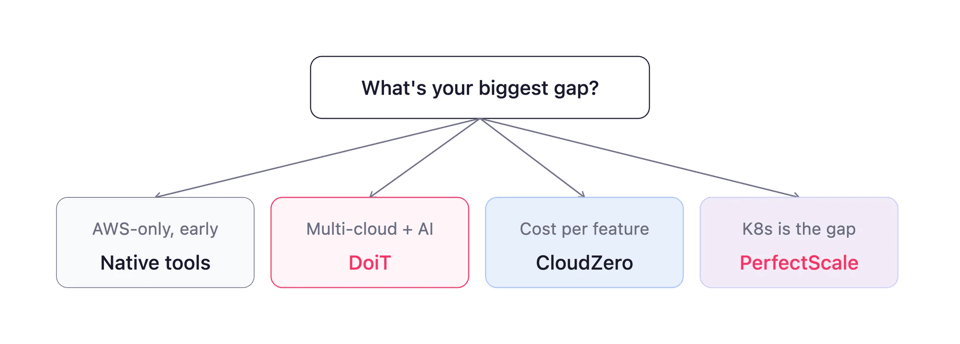
| Your situation | Start with | Layer in later |
|---|---|---|
| AWS-only, early-stage FinOps | AWS Cost Explorer | A multi-cloud platform once you add a second provider |
| Multi-cloud with AI or agent spend growing fast | DoiT Cloud Intelligence or Vantage | Dedicated AI/agent attribution if it isn't already included |
| Need to answer "what does this customer or feature cost" | CloudZero | An automation layer, like ProsperOps or CAST AI, for the fixes it surfaces |
| Kubernetes is the biggest waste driver | PerfectScale for Kubernetes or CAST AI for pod- and node-level automation, Kubecost for allocation first | A general cost platform for non-container spend |
| Already standardized on Harness for CI/CD | Harness Cloud & AI Cost Management | Little else, it's built to be the single pane for that workflow |
| Regulated enterprise that needs enforcement, not just reporting | Kion | A unit-economics layer for the business side of the house |
| Tagging is inconsistent, or a CMDB already exists | Cloudaware | Automation specialists once allocation is trustworthy |
| Finance leads the initiative | Cloudability by IBM | Engineering-facing automation tools alongside it |
What Else Should You Check Before You Sign?
A few things don't show up cleanly in a feature comparison table but matter just as much once you're actually running the tool.
- Multi-cloud coverage: Check whether the platform covers every cloud provider you actually run, not just the one you run the most of. A tool that's excellent on AWS and an afterthought on Azure will leave a real gap the moment your Azure spend grows past a rounding error.
- Automation vs. manual effort: Check whether it remediates or only recommends. A tool that flags an oversized instance is doing half the job; one that can resize it, or route the fix to whoever owns it, is doing the other half.
- Pricing that adapts to growth: Check the pricing model against your own growth curve. A percentage-of-spend model that looks reasonable today can get expensive fast if your cloud bill is about to grow, while a flat or per-asset model can do the opposite.
- Recent organizational changes: Check vendor stability directly with the vendor if the platform has changed hands recently. CloudHealth (now under Broadcom) and Cloudability (now under IBM) both went through ownership changes worth asking about directly rather than assuming continuity.
One more criterion is becoming harder to ignore: whether the tool extends cost visibility to AI and LLM spend, not just traditional compute and storage. Several platforms in this guide, including DoiT, Vantage, Harness, CloudZero, and Finout, already track cost from providers like OpenAI and Anthropic alongside cloud infrastructure. Gartner's own research signals this is moving from a nice-to-have to a weighted evaluation criterion, and we'll cover it in more depth in a dedicated piece on AI cost management tooling.
It's also worth knowing what none of the tools above cover well: data warehouse and data platform spend. Snowflake, Databricks, and BigQuery consumption runs on its own credit and compute-second pricing model that general cloud cost management platforms typically don't reach into with any depth.
SELECT, now offered by DoiT as PerfectScale for Data Platforms, is built specifically for that layer, with query-level attribution and automated warehouse optimization for Snowflake, Databricks, and BigQuery. If data platform spend is a meaningful share of your bill, evaluate it alongside whichever tool from this guide covers your broader cloud infrastructure.
How Do You Run a Fair Evaluation?
A demo tells you what a vendor wants to show you. A structured evaluation tells you what the tool actually does with your data.
Score every vendor against the four mandatory capabilities from Gartner's framework, not the feature the salesperson leads with. Test cost allocation against your actual tagging hygiene, not a clean sandbox account the vendor set up for the demo.
Ask for remediation, not just recommendations, during any proof-of-concept, since the gap between "we found the problem" and "we fixed the problem" is where most of the value either shows up or doesn't. And check Gartner Peer Insights and G2 reviews for the specific capability you're weakest on today, rather than an overall star rating that averages out strengths you don't actually need.
Where Does DoiT Fit?
DoiT Cloud Intelligence holds Visionary placement in Gartner's Magic Quadrant for Cloud Financial Management Tools, discussed in more detail in our explainer on the methodology and in the full placement announcement.
That placement covers the core platform, but DoiT's actual footprint in this guide is broader than any single row in the ranking table, including:
PerfectScale for Kubernetes handles the pod-level automation profiled above.
PerfectScale for Commitments automates and ladders Savings Plans and Committed Use Discounts across AWS and Google Cloud with guardrails you set, rather than a single upfront bet.
PerfectScale for Data Platforms, built on the SELECT product DoiT acquired, extends that same approach to Snowflake, Databricks, and BigQuery.
And for teams that would rather not buy cloud direct from the hyperscalers at all, DoiT's reseller and procurement advisory service adds partner pricing, Enterprise Discount Program and Private Pricing Agreement guidance, and a single consolidated invoice across AWS, Google Cloud, and Azure, without changing how your teams actually use the cloud.
If you're mid-evaluation and want to see how any of this, the platform, PerfectScale, or the reseller model, handles anomaly detection, remediation, and AI cost attribution against your actual environment, book a demo to walk through it directly.
FAQ
What's the difference between a cloud cost management tool and a FinOps tool? The terms overlap heavily in practice. Cloud cost management tools are the software that makes FinOps possible at scale, handling visibility, allocation, and optimization. FinOps itself describes the operating model and cross-functional practice, finance, engineering, and business teams working from shared cost data, that the tooling supports.
How many cloud cost management tools are there? Dozens of credible platforms compete across at least four distinct categories: cost visibility and intelligence, automation and remediation, governance and policy enforcement, and native single-cloud tools. The count matters less than matching the category to your actual gap. Buying a visibility tool when you need automation, or a governance platform when you need unit economics, is a more expensive mistake than picking the wrong vendor within the right category.
What's the difference between a cost visibility tool and a cost automation tool? Visibility and intelligence tools answer "why did this cost what it cost," mapping spend to teams, features, or customers. Automation tools answer "fix it for me," taking action on waste, rightsizing, or commitment coverage without waiting for someone to implement a recommendation. Most mature FinOps programs end up running at least one tool from each category rather than expecting a single platform to do both equally well.
How much do cloud cost management tools cost? Pricing models vary more than most buyers expect. Some vendors charge a percentage of managed cloud spend, typically in the 0.6% to 1% range depending on scale. Others use a percentage of realized savings, flat or tiered SaaS pricing, or price per configuration item or CI run tracked. Model the total cost against your own spend and asset count rather than comparing headline rates across vendors.
Can I just use my cloud provider's native tools instead of buying a separate platform? Native tools like AWS Cost Explorer work well for single-cloud environments early in their FinOps maturity. The limitations show up once you're multi-cloud, need cross-provider attribution, or want automated remediation rather than recommendations you have to act on manually.
What's the difference between cloud cost management and cloud cost optimization? Cost management is the broader discipline: visibility, allocation, forecasting, and governance. Cost optimization is the subset focused specifically on reducing spend, rightsizing, commitment coverage, and eliminating waste. Most platforms in this guide cover both, though they weight them differently.
Do cloud cost management tools work equally well across AWS, Azure, and Google Cloud? Not always. Several platforms started on one cloud and expanded, which can leave gaps in depth on the others. Check a vendor's coverage against the specific services you run heavily, not just whether the provider appears on their integrations page.


