
Cloud Intelligence™
Gartner Magic Quadrant: Cloud Financial Management Explained
What is the Gartner Magic Quadrant for Cloud Financial Management Tools? Learn how Gartner evaluates CFM vendors and what each quadrant means.
This page is also available in Deutsch, Español, Français, Italiano, 日本語, and Português.


About Josh Palmer
I'm Josh Palmer, Head of Content at DoiT, where I split my time across multiple business units including DoiT Cloud Intelligence, PerfectScale (Kubernetes cost optimization), and SELECT (Snowflake, Databricks, and BigQuery cost optimization). Before DoiT, I spent four and a half years at OnBoard building content for a board intelligence platform used by 6,000+ organizations, and before that, two years as Content Marketing Manager at Zylo, a SaaS management platform.
My personal pageTL;DR: A Gartner Magic Quadrant is a research methodology that plots vendors in a market against two dimensions: Ability to Execute and Completeness of Vision. The result is four categories: Leaders, Challengers, Visionaries, and Niche Players. Gartner's Magic Quadrant for Cloud Financial Management (CFM) Tools evaluates vendors that help enterprises collect, monitor, and optimize public cloud spend. Gartner sizes the CFM tooling market at roughly $1 billion in 2024, growing to more than $1.75 billion by 2028. Here's how the methodology works and what it means if you're evaluating a cloud cost management tool.
Enterprises now have well over 100 vendors to choose from when they go looking for a way to manage cloud spend, and most of those vendors describe themselves the same way: AI-powered, automated, enterprise-grade. That makes an independent evaluation framework useful. Gartner's Magic Quadrant for Cloud Financial Management Tools gives buyers a consistent way to compare vendors on the same criteria, rather than taking each vendor's own claims at face value.
What Is a Gartner Magic Quadrant?
A Magic Quadrant is a research methodology Gartner uses to evaluate and compare vendors in a specific technology market. It plots each vendor on a two-axis grid: Completeness of Vision along the horizontal axis, and Ability to Execute along the vertical axis. The resulting four quadrants (Leaders, Challengers, Visionaries, and Niche Players) give buyers a quick visual summary of where each vendor stands, backed by a detailed written analysis of that vendor's strengths and cautions.
The quadrant placement itself is only part of the research. Gartner also publishes a market definition, an inclusion and exclusion criteria section explaining which vendors qualified for evaluation and why, and a market overview covering broader trends. For buyers, that supporting analysis is often more useful than the quadrant graphic alone.
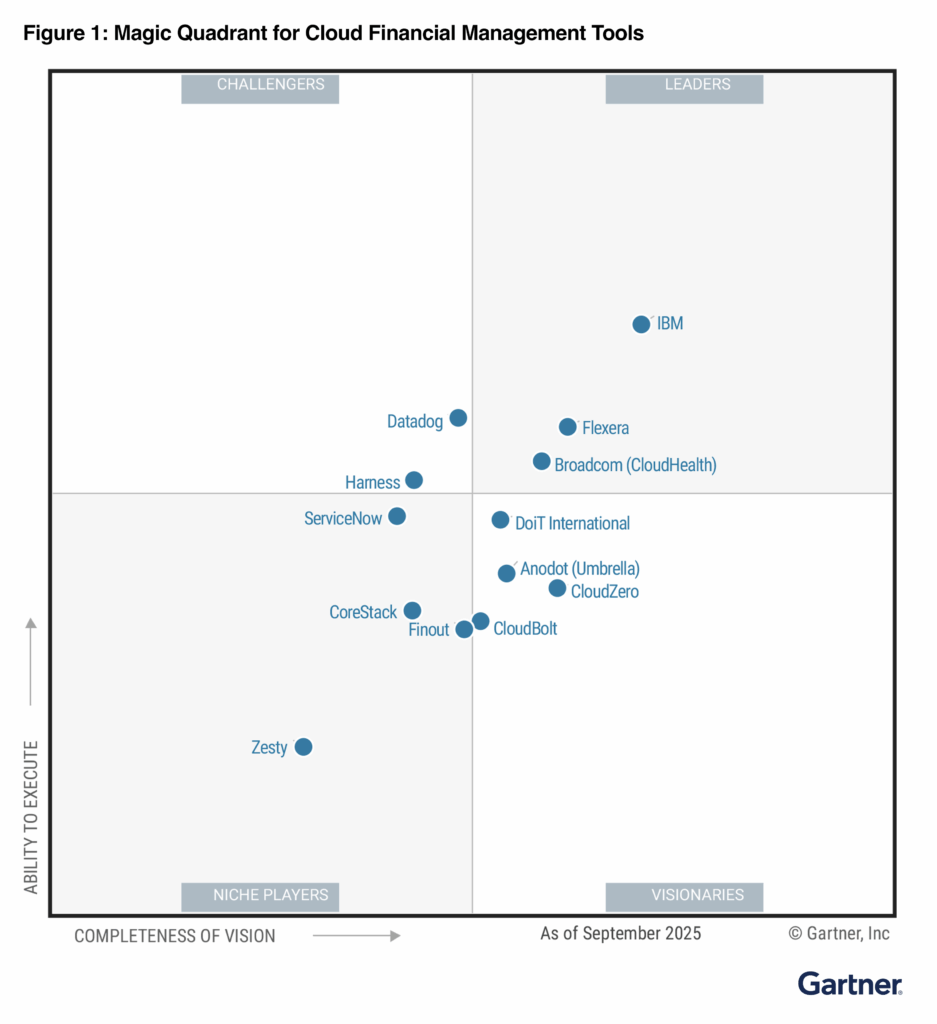
Gartner's September 2025 Magic Quadrant for Cloud Financial Management Tools, shown here as an example of how the four-quadrant layout works in practice. Vendor positions reflect that specific report and will shift with each new edition. Source: Gartner (September 2025).
What Does "Cloud Financial Management" Mean to Gartner?
Cloud financial management (CFM) tools, in Gartner's definition, are tools that help organizations collect, organize, display, and optimize their spending on public cloud infrastructure as a service (IaaS) and platform as a service (PaaS). Vendors in this market typically use a combination of dashboards, statistical models, and AI or machine learning to help teams monitor cost and utilization, catch anomalies, and act on opportunities to run cloud workloads more efficiently.
Gartner's research defines a set of mandatory capabilities that a tool needs before it qualifies as a true CFM platform, not just a reporting dashboard:
- Managing financial risk. Detecting anomalies, budget overruns, and deviations from expected spend before they become expensive surprises.
- Forecasting and estimation. Using historical usage patterns to predict future cloud spend and improve budget accuracy.
- Increasing efficiency. Optimizing cloud configurations, architecture, and contracts to get better ROI from existing cloud investments.
- Increasing accountability. Showback and chargeback capabilities that connect cloud spend back to the teams and workloads responsible for it.
CFM overlaps heavily with FinOps, the operating model and community of practice that brings finance, engineering, and business teams together around cloud cost decisions. The distinction is that FinOps describes the practice and culture, while CFM tools are the software that makes the practice possible at scale.
How Does Gartner Evaluate CFM Vendors?
Gartner scores every vendor in the Magic Quadrant against two sets of weighted criteria: Ability to Execute and Completeness of Vision. Both matter, but they measure different things. Ability to Execute looks at how well a vendor delivers today. Completeness of Vision looks at how well a vendor understands where the market is going.
Ability to Execute criteria
| Criterion | Weight |
|---|---|
| Product or Service | High |
| Overall Viability | High |
| Market Responsiveness/Record | High |
| Sales Execution/Pricing | Medium |
| Marketing Execution | Medium |
| Customer Experience | Medium |
| Operations | Medium |
Completeness of Vision criteria
| Criterion | Weight |
|---|---|
| Market Understanding | High |
| Offering (Product) Strategy | High |
| Innovation | High |
| Marketing Strategy | Medium |
| Sales Strategy | Medium |
| Business Model | Medium |
| Vertical/Industry Strategy | Low |
| Geographic Strategy | Low |
Notice what carries the most weight on each side: product capability and market responsiveness on execution, and market understanding, product strategy, and innovation on vision. A vendor can't buy its way into a strong placement with marketing spend alone; the heaviest-weighted criteria are all about whether the product actually works and where it's headed next. Source: Gartner, September 2025.
What Do Leaders, Challengers, Visionaries, and Niche Players Actually Mean?
Each quadrant describes a different combination of execution and vision, and none of them is automatically the "right" answer for every buyer.
- Leaders execute well today and have an ambitious roadmap. They typically serve a broad range of use cases and have significant market share, though they may not be the best fit for every specific need.
- Challengers deliver solid, proven service for a particular set of use cases but move more cautiously on vision. They're often a safe choice for a well-defined need, just not necessarily the most forward-looking one.
- Visionaries are investing heavily in where the market is headed, often with unique or emerging capabilities. Their execution may still be catching up to their ambition, which can mean some capabilities are newer or less broadly proven.
- Niche Players tend to excel at a specific use case, region, or customer segment rather than serving the whole market. That specialization can be exactly what a buyer with a narrow need is looking for.
The practical takeaway for buyers: match the quadrant to your own priorities. A team that wants proven, broad functionality today should weight Leaders and Challengers more heavily. A team willing to invest alongside a vendor's roadmap, in exchange for capabilities that don't exist anywhere else yet, has good reason to take Visionaries seriously.
What Should You Actually Look For in a CFM Tool?
Beyond the mandatory capabilities above, Gartner's research outlines the common features that separate a mature CFM platform from a basic cost dashboard. When you're evaluating vendors yourself, this list doubles as a practical checklist:
- Configurable, multi-persona dashboards that give a CFO, a CIO, an engineer, and an individual developer each the level of detail they actually need.
- Cost incident and anomaly detection that flags misaligned spend automatically, rather than requiring someone to notice it in a report.
- AI- or ML-driven analytics that surface optimization opportunities across configuration, architecture, and contracts.
- Utilization monitoring across compute, storage, database, and container services, including Kubernetes workloads.
- Budget controls with the ability to forecast against a defined spending scope, not just report on what already happened.
- Resource optimization controls: rightsizing, idle-resource identification, autoscaling, and commitment management (reserved instances, savings plans, and similar programs across AWS, Microsoft Azure, and Google Cloud).
- Remediation workflows that can actually act on a finding, whether that's a one-click fix or an integration with a ticketing system like Jira or ServiceNow.
A tool that only reports on spend, without some path to acting on what it finds, is solving half the problem. The remediation piece is often what separates a dashboard from a true CFM platform.
Cloud bill shouldn't be a mystery
One platform for AI and Cloud optimization.
How Big Is the Cloud Financial Management Market?
Gartner sizes the CFM tooling market at approximately $1 billion in 2024, with growth forecast to exceed $1.75 billion by 2028, a compound annual growth rate of about 15%. That growth tracks with a broader trend: as public cloud adoption keeps climbing, so does scrutiny of whether that spend is actually delivering value. Gartner's research notes that dissatisfaction with cloud spend, not the spend itself, is often what pushes enterprises to formalize a CFM practice and invest in dedicated tooling. Source: Gartner, September 2025.
What's Changing in the Next Magic Quadrant?
Gartner's own conference schedule is a preview of where this research is headed. A session at the December 2026 Gartner IT Infrastructure, Operations & Cloud Strategies Conference in Tokyo is titled "Magic Quadrant for Cloud and AI Financial Management Tools," shortened to CAIFM. The session description explains the reasoning: vendors are increasingly evaluated on more than cloud spend, including "how they are enabling the cost management and optimization of AI workloads."
The practitioner data backs that up. The FinOps Foundation's State of FinOps 2026 report, based on a survey of nearly 1,200 practitioners representing more than $83 billion in annual cloud spend, found that 98% of FinOps teams now manage AI spend, up from 63% in 2025 and just 31% in 2024. AI cost management ranks as the single most desired skillset FinOps teams are looking to add over the next year, and "granular monitoring of AI spend (tokens, LLM requests, and GPU utilization)" topped practitioners' list of tooling capabilities that don't exist yet. A number of respondents said they're being asked to self-fund new AI investment out of savings found through cloud optimization, which ties the two disciplines together directly rather than treating them as separate line items.
DoiT's own research points to the same pressure from a different angle. A February 2026 survey of 500 finance leaders at organizations already spending on AI, commissioned by DoiT and fielded independently by Sapio Research, found that AI now accounts for a mean of 17.6% of total technology spend. Yet 79% of respondents had experienced AI-related cost overruns in the past 12 months, and only 15% could calculate AI ROI without significant bottlenecks. The most counterintuitive result: organizations that rate their own FinOps practice as very mature or leading-edge posted the highest overrun rate in the dataset, at 89%. That's not evidence that mature governance fails; those organizations run larger, more complex AI projects and are better equipped to detect overruns that less mature teams simply miss. See the full survey results.
None of this changes the mandatory and common features covered above; those still describe what a CFM platform needs to do. What it does suggest is that the evaluation criteria are likely to weigh a vendor's ability to attribute and optimize AI and LLM spend, alongside traditional compute, storage, and container costs, more heavily than in prior cycles. We'll update this page, and DoiT's placement below, once the renamed report actually publishes.
Where Does DoiT Fit Into the Cloud Financial Management Market?
DoiT International, the team behind DoiT Cloud Intelligence, is one of the vendors Gartner evaluates in its Magic Quadrant for Cloud Financial Management Tools. For DoiT's current placement and the reasoning behind it, see DoiT's Gartner Magic Quadrant recognition.
If you're in the middle of evaluating CFM vendors against the criteria above, it's worth seeing how DoiT Cloud Intelligence approaches anomaly detection, remediation, and multi-persona reporting firsthand.
Frequently asked questions
What is a Gartner Magic Quadrant? A Gartner Magic Quadrant is a research methodology that evaluates vendors in a specific technology market against two dimensions, Ability to Execute and Completeness of Vision, and groups them into four categories: Leaders, Challengers, Visionaries, and Niche Players.
What's the difference between a Leader and a Visionary in a Magic Quadrant? Leaders score well on both execution and vision today. Visionaries score well on vision, meaning they're investing in where the market is headed, but their execution and breadth of proven use cases are still catching up.
What is cloud financial management (CFM)? Cloud financial management is the practice, and the software category, focused on collecting, monitoring, forecasting, and optimizing an organization's spend on public cloud infrastructure. It overlaps closely with FinOps, which describes the cross-functional operating model that CFM tools support.
Is the Magic Quadrant for Cloud Financial Management Tools the same as the one for cloud cost management? Gartner's report is officially titled the Magic Quadrant for Cloud Financial Management Tools. Many buyers still search using earlier terminology like "cloud cost management tools," since the two phrases describe closely overlapping capability sets.
Do all cloud cost management vendors appear in the Magic Quadrant? No. Gartner applies specific inclusion criteria, including minimum revenue thresholds, general availability of the product as of a defined cutoff date, and support for at least two major public cloud providers. Only a fraction of the vendors in this space meet the bar for inclusion in any given year.
Is Gartner renaming the Magic Quadrant for Cloud Financial Management Tools? Signs point that way. A session at Gartner's December 2026 IT Infrastructure, Operations & Cloud Strategies Conference already refers to it as the Magic Quadrant for Cloud and AI Financial Management (CAIFM) Tools, reflecting how much of the vendor evaluation now centers on managing AI workload costs alongside traditional cloud spend.
How common are AI-related cost overruns? Common enough to be the norm rather than the exception. A DoiT-commissioned survey of 500 finance leaders, fielded independently by Sapio Research in February 2026, found that 79% had experienced AI-related cost overruns in the past 12 months, a rate that climbed to 89% among organizations that rate their own FinOps practice as most mature.


