
Cloud Intelligence™
Cloud Financial Management: The Complete 2026 Guide
The four pillars of CFM, a 5-step rollout plan, and why FinOps tools, cloud spend management, and CFM software all describe the same software category.
This page is also available in Deutsch, Español, Français, Italiano, 日本語, and Português.


About Josh Palmer
I'm Josh Palmer, Head of Content at DoiT, where I split my time across multiple business units including DoiT Cloud Intelligence, PerfectScale (Kubernetes cost optimization), and SELECT (Snowflake, Databricks, and BigQuery cost optimization). Before DoiT, I spent four and a half years at OnBoard building content for a board intelligence platform used by 6,000+ organizations, and before that, two years as Content Marketing Manager at Zylo, a SaaS management platform.
My personal pageTL;DR: Cloud financial management (CFM) is the discipline of tracking, governing, optimizing, and forecasting cloud spend so it stays tied to business value. It rests on four pillars: visibility, governance, optimization, and forecasting. FinOps is the collaborative operating model that puts those pillars into practice. The software that supports both goes by at least six overlapping names, FinOps tool, FinOps software, FinOps solution, cloud spend management platform, cloud cost management tool, and CFM platform, because vendors and analysts never agreed on one label. This guide covers the five-step implementation framework first, then walks through why the naming is such a mess and what to actually check before you buy.
As more organizations move to the cloud, one challenge keeps resurfacing: keeping financial control while infrastructure scales on the fly. What starts as a straightforward cost optimization project often turns into a balancing act between performance, innovation, and budget.
Cloud financial management has become a core focus for finance leaders because cloud environments don't behave like traditional IT budgets. Traditional budgets were predictable and mostly fixed. Cloud spend runs on variable pricing, on-demand scaling, and multi-service architectures, which turns cost tracking into a moving target.
The stakes have grown, too. Organizations without a real CFM framework run into budget overruns, resource waste, and blind spots on their largest technology investments. A structured approach fixes that without forcing a trade-off between cost and service quality.
Quick Answers: Cloud Financial Management
| Question | Answer |
|---|---|
| What is cloud financial management (CFM)? | Cloud financial management is the practice of tracking, governing, optimizing, and forecasting cloud spend so costs stay aligned with business value. |
| What are the four pillars of cloud financial management? | Visibility and analytics, governance and accountability, optimization and automation, and planning and forecasting. |
| How is CFM different from FinOps? | CFM is the broader discipline. FinOps is a collaborative operating model and set of practices within CFM that emphasizes cross-functional accountability and continuous optimization. |
| Is a FinOps tool the same thing as a CFM platform? | Usually, yes, in terms of what the software actually does. The label mostly reflects which vendor, which analyst firm, or which era of the market you're looking at, not a real difference in capability. The section below unpacks why. |
What Are the Four Pillars of Effective Cloud Financial Management?
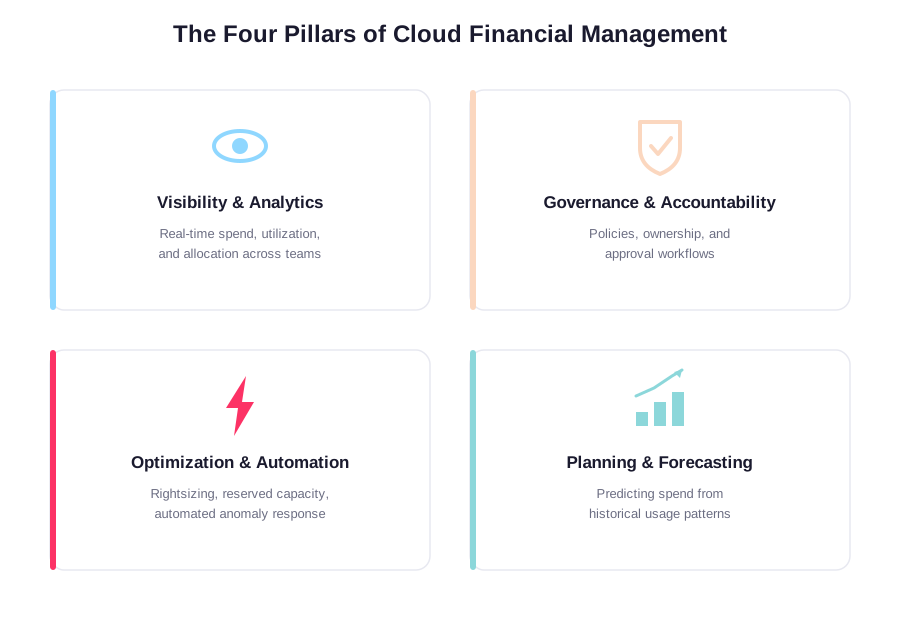
Successful cloud financial management rests on four fundamental pillars that work together to create sustainable cost optimization and governance.
1.Visibility and analytics forms the foundation. It provides real-time insight into spending patterns, resource utilization, and cost allocation across teams and projects. Without full visibility, organizations make decisions on incomplete information, which leads to reactive cost management instead of proactive, strategic planning.
2.Governance and accountability establishes the policies, processes, and ownership structures that guide cloud spending decisions. This pillar turns cost optimization into a shared responsibility rather than a finance-only concern, by setting clear guidelines for provisioning, tagging, and approval workflows.
3.Optimization and automation puts tools and processes in place that continuously identify and act on savings opportunities. This includes rightsizing resources, using reserved capacity, applying autoscaling policies, and setting automated responses to cost anomalies. Tools like Azure Advisor and Google Cloud's Recommender can flag unusual spending patterns before they compound.
4.Planning and forecasting lets organizations predict future cloud costs based on business growth, seasonal patterns, and planned initiatives. Accurate forecasting helps teams budget effectively and negotiate better contracts with cloud providers, while tying technology investment to specific business objectives.
What's the Difference Between Cloud Financial Management and FinOps?
Cloud financial management and FinOps get used interchangeably, but they cover different parts of the same problem. CFM is the broader discipline: everything from strategic planning to tactical optimization of cloud costs. FinOps is a specific methodology inside CFM that focuses on collaboration between finance, operations, and engineering. It borrows DevOps-style practices, automation, measurement, and iterative improvement, and applies them to financial management.
Think of cloud financial management as the destination and FinOps as one proven path there. FinOps contributes concrete frameworks to that journey: the three-phase lifecycle (Inform, Optimize, Operate), standardized metrics like unit economics and cost per service, and automated optimization practices that go beyond team collaboration alone.
Why Do Vendors and Analysts Call the Same Software Six Different Names?
Search for a cloud cost platform and you'll run into some combination of these labels, often on the same vendor's own site: FinOps tool, FinOps software, FinOps solution, cloud spend management platform, cloud cost management tool, and cloud financial management (CFM) platform. Buyers reasonably assume these terms mean different things. Mostly, they don't.
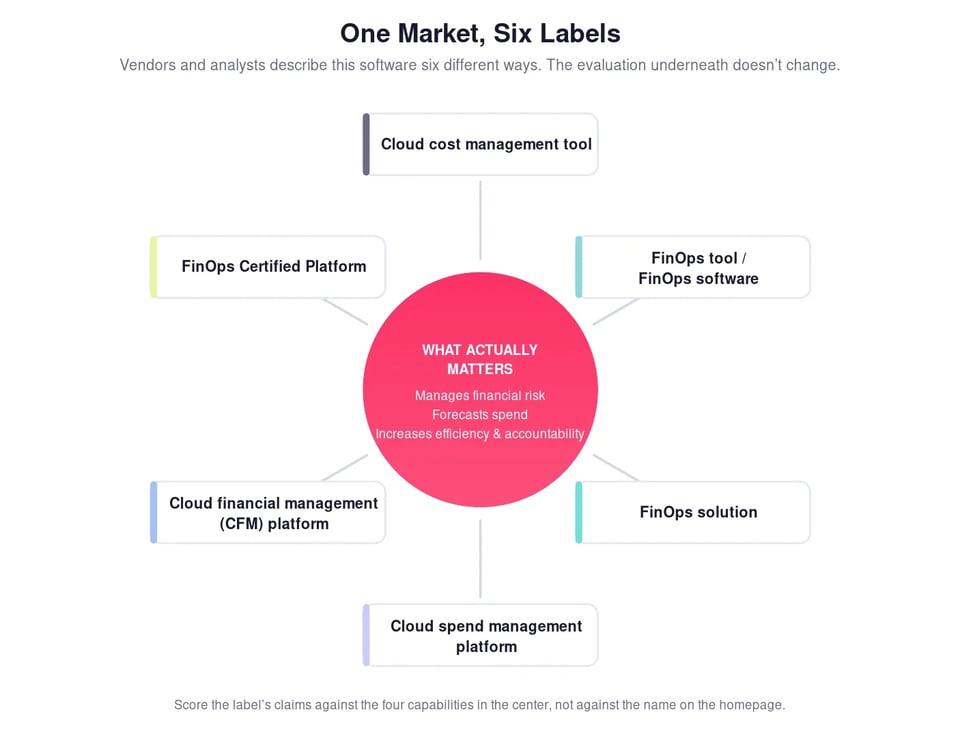
The confusion has a history. Cloud cost management was the original term, born out of AWS Cost Explorer and the first generation of billing dashboards. The FinOps Foundation popularized FinOps starting in 2019 as the name for the practice and the community around it, not a product category. Tool vendors adopted FinOps tool and FinOps software anyway, because that's where the community, the certifications, and the buyer research had gathered. Gartner then coined cloud financial management (CFM) tools as its own analyst-market label, partly to capture vendors that never called themselves FinOps anything: native cloud tools, CMDB-based platforms, and governance-first tools like Kion. Cloud spend management is the plainest term of the bunch.
Analyst firms haven't converged on one term either. Gartner's report is the Magic Quadrant for Cloud Financial Management Tools, and a session already scheduled for Gartner's December 2026 conference in Tokyo points to another rename, to Cloud and AI Financial Management (CAIFM) Tools, reflecting how much of the evaluation now centers on AI workload cost. We cover that shift in more depth in our Gartner Magic Quadrant explainer.
Forrester, evaluating largely the same vendors, titles its report The Forrester Wave: Cloud Cost Management and Optimization Solutions.
Even the FinOps Foundation, the group that put "FinOps" into buyers' vocabulary in the first place, certifies vendors under the name FinOps Certified Platform, not "FinOps tool."
| Term | Who tends to use it | What it actually describes |
|---|---|---|
| Cloud cost management tool | Earlier-generation vendors, native cloud dashboards | The original, broadest label. Visibility and basic optimization of cloud spend. |
| FinOps tool / FinOps software | Vendors that grew up alongside the FinOps Foundation community | Software built to support the FinOps operating model: allocation, unit economics, cross-team accountability. |
| FinOps solution | Vendors marketing to a buyer already sold on FinOps as a practice | Functionally the same as a FinOps tool. "Solution" is a positioning word, not a different capability set. |
| Cloud spend management platform | Buyer-side search, vendors targeting less jargon-fluent buyers | Plain-language synonym for the same category, used earlier in a buyer's research. |
| Cloud financial management (CFM) platform | Gartner, and vendors chasing Gartner's evaluation criteria | The analyst-market label. Broadest coverage, including tools that never called themselves "FinOps" anything. |
| FinOps Certified Platform | The FinOps Foundation's own certification program | An official designation, not a generic category name, awarded to vendors whose product meets FinOps Framework capabilities. |
The same inconsistency shows up one level down, in the billing data these tools ingest. The FinOps Foundation's FOCUS specification, short for FinOps Open Cost and Usage Specification, exists because AWS, Azure, Google Cloud, Databricks, and dozens of other providers each formatted billing data differently, which made comparing one FinOps tool's output against another unreliable even when both tools worked fine on their own. FOCUS reached version 1.4 in June 2026, adding new datasets and glossary entries aimed at commitment comparison and invoice reconciliation, with future versions planned to extend into data center and AI spend. It's a useful reminder that the terminology problem in this market runs deeper than marketing copy. Standardizing what the software reports matters more than standardizing what it's called.
None of this makes the label meaningless. It's a hint about a vendor's origin story, not a specification of what the product does. A tool that still calls itself a FinOps tool probably grew up inside the FinOps community and likely integrates cleanly with FOCUS-formatted data and FinOps Foundation frameworks. A tool that leads with cloud spend management is probably speaking to a buyer earlier in their research, before they've learned the category vocabulary. A CFM platform is usually chasing Gartner's specific evaluation criteria.
But none of that tells you whether the tool manages financial risk, forecasts accurately, increases efficiency, or increases accountability, the four capabilities Gartner uses to separate a real platform from a reporting dashboard. Score a vendor's claims against those four, not against whatever label sits on their homepage. Our buyer's guide profiles how the leading tools stack up against exactly those four criteria if you want the vendor-by-vendor version of this exercise.
What Cloud Costs Should You Actually Monitor?
Managing cloud finances effectively means knowing which costs carry the biggest impact on budget and operations. Not all cloud spending deserves the same attention, and focusing on the right metrics helps teams prioritize their optimization work. Early-stage companies should focus mainly on compute costs, which typically run 60% to 80% of their bill, while more mature enterprises benefit from balancing compute optimization against storage lifecycle management and network architecture reviews.
Compute costs usually represent the largest share of cloud bills: virtual machines, containers, serverless functions, and specialized processing units. These costs fluctuate with usage patterns, instance types, and scaling behavior, which makes them prime targets for rightsizing, scheduling, and reserved capacity strategies.
Storage costs, while often smaller in absolute terms, can grow unpredictably because of data retention policies, backup strategies, and inconsistent lifecycle management. Many organizations overlook storage optimization entirely, which leaves unused volumes, backups kept far longer than needed, and the wrong storage class sitting on the books.
Network and data transfer costs surprise organizations more than any other line item, especially those running multi-region architectures or handling heavy data egress. These costs tie directly to application design and can meaningfully change the total cost of running a distributed system.
Hidden or ancillary costs deserve dedicated attention too, precisely because teams overlook them until they've accumulated. Logging services that charge per gigabyte ingested, monitoring tools with per-metric pricing, security scanning, and managed databases billed on IOPS or connection counts all add up quietly.
What Are the Five Steps for Effective Cloud Financial Management?
Implementing cloud financial management takes a clear plan that addresses both technical and organizational challenges. These five steps give you a framework for building sustainable cost optimization practices.
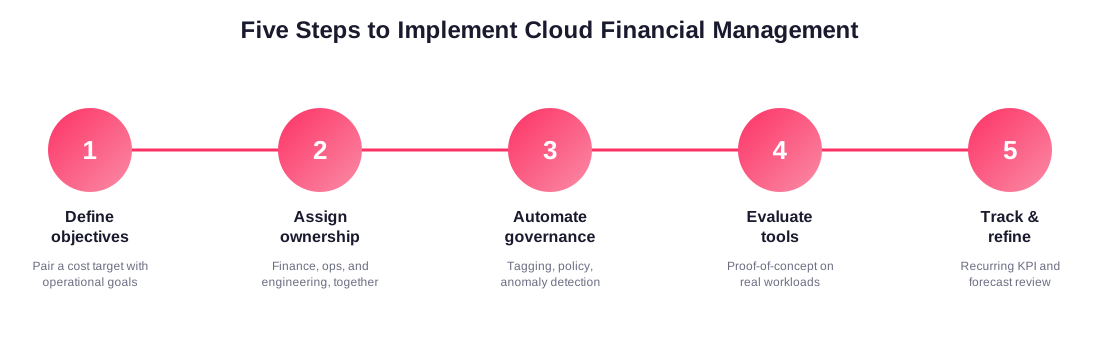
1. Define clear objectives
Set measurable objectives for your CFM program before implementing any tools or processes. Objectives should align with broader business goals while addressing specific pain points in your current cost management practice. Cloud-native startups should prioritize unit economics and cost-per-customer metrics, while traditional enterprises benefit more from reducing budget variance and improving cost allocation accuracy.
Effective objectives typically pair a specific cost reduction target, such as 15% to 25% savings within the first year, with operational goals like reducing budget variance by 80% or hitting 95% cost allocation accuracy. Objectives shouldn't focus on cost reduction alone. Many organizations also target better forecasting accuracy, faster decision cycles, and clearer visibility into spending patterns.
Establish both leading and lagging KPIs to get a complete picture of progress. Leading KPIs predict future performance: tagging standard adoption, completed rightsizing recommendations, automated policies in place. Lagging KPIs measure results after the fact: actual cost savings, reduced budget variance, improved allocation accuracy.
2. Assign cross-functional ownership
Cloud financial management works when it becomes a shared responsibility across finance, operations, and engineering, rather than staying siloed in one department. This collaborative approach integrates cost considerations into both technical and business decisions.
Finance teams bring budgeting expertise, cost allocation knowledge, and business context. They understand how cloud costs affect overall financial performance and can set governance frameworks and approval processes accordingly. Operations and engineering teams bring the technical knowledge: resource utilization patterns, application architecture, and where the real optimization opportunities sit. They also know how a proposed change might affect performance, which makes them essential to implementing fixes correctly.
Clearly defined roles across these teams close accountability gaps and make sure cost decisions weigh both financial and technical needs. Regular touchpoints, weekly cost reviews or monthly optimization planning, keep the alignment from drifting.
3. Automate cost governance
Manual cost management doesn't scale with cloud environments that can provision thousands of resources in minutes. Automation keeps costs in check without sacrificing the flexibility that makes cloud computing valuable in the first place.
Automated governance starts with consistent tagging through tools like AWS Resource Groups, Azure Policy, or Google Cloud's Resource Manager. Tags should capture project, cost center, environment, and ownership details, so organizations can track spending across multiple dimensions automatically.
Policy enforcement platforms prevent overruns by capping resource provisioning, requiring approval for expensive instance types, or terminating resources after a set period. AWS Organizations Service Control Policies, Azure Policy, and Google Cloud's Organization Policy all balance cost control with operational flexibility, letting standard operations run while flagging anything unusual.
Anomaly detection systems catch cost spikes, budget variances, and optimization opportunities as they happen rather than during a monthly review. Native tools like AWS Cost Anomaly Detection work alongside third-party platforms to trigger automated responses, scaling down idle resources or notifying the right team when spend crosses a threshold.
4. Evaluate tools and integrations
Native cloud provider tools cover basic cost management, but most organizations need more to reach comprehensive CFM. The goal is picking tools that integrate cleanly with existing systems while closing specific gaps in current capability.
Native tools like AWS Cost Explorer, Google Cloud Billing, and Azure Cost Management handle foundational cost tracking and basic recommendations well. They work fine for simple, single-cloud environments but tend to lack the advanced analytics, multi-cloud support, and workflow integration that complex operations need.
Third-party platforms add stronger analytics, automated optimization, and better integration with financial systems. Finance-led teams should prioritize ERP integration, detailed cost allocation, and executive dashboards. Engineering-led teams need API access, workload-level visibility, and integration with existing monitoring tools. Operations-focused teams get the most value from automation capabilities and workflow integration.
Run any evaluation with a proof-of-concept against real workloads and real data, not a clean demo account. Weigh both short-term functionality and long-term scalability so the tool you pick can grow with the organization.
5. Track and refine metrics
Continuous improvement takes ongoing measurement. Set regular review cycles that assess both cost performance and process effectiveness.
KPIs should span multiple dimensions: cost trends, optimization success rates, budget accuracy, and process efficiency. Financial metrics might include cost per transaction or unit economics. Operational metrics might track recommendation implementation rates or time to resolve a cost anomaly.
Regular reviews, whether weekly operational sessions or monthly strategic check-ins, give teams a chance to spot trends, recognize wins, and address problems early. Include finance, operations, and engineering in these reviews to keep cross-functional alignment intact, and tie them to your forecasting refresh cycle.
Cloud bill shouldn't be a mystery
One platform for AI and Cloud optimization.
What Are the Core Challenges in Optimizing Cloud Spend?
Even with the right tools and best practices in place, organizations still struggle to get cloud spending under control. These challenges compound each other, which is worth understanding before building a strategy.
Complexity creates the foundation for the problem. Today's cloud environments span multiple providers, services, and pricing models, which makes it hard to identify true costs, compare alternatives, or apply optimization strategies consistently. That complexity keeps teams from establishing the baseline metrics good optimization depends on.
Tool fragmentation compounds it further. Organizations accumulate monitoring, optimization, and reporting tools over time to chip away at complexity, and end up with "tool fatigue," where teams spend more time reconciling conflicting data sources than actually optimizing costs.
Cultural resistance shows up as a defensive response to both of the above. Engineers push back on rightsizing recommendations they read as a performance risk, while business teams treat cost controls as friction against innovation. Even well-researched recommendations go unimplemented when a team resists a change it sees as a threat to performance or speed.
What Are the Benefits of Doing CFM Well?
Organizations that implement cloud financial management successfully see benefits well beyond simple cost reduction.
Financial benefits include direct cost savings, often 15% to 25% in the first year, better budget predictability, and sharper forecasting accuracy. That combination supports better financial planning and lowers the risk of overruns that disrupt other business initiatives.
Operational benefits include clearer visibility into resource usage, faster detection of performance issues, and smarter resource allocation decisions. Teams gain a real understanding of which applications and services actually drive cost, which supports better architectural and operational decisions overall.
Strategic benefits show up as faster market response. Teams can evaluate new services and scale initiatives with confidence in the cost implications, which shortens time to market for new features. Organizations with mature CFM practices make faster, more confident decisions about cloud adoption generally.
How Do You Use CFM Tools to Actually Reduce Costs?
Effective cloud financial management depends on selecting and implementing the right combination of tools for your specific organizational and technical needs.
Multi-cloud visibility
Managing costs across multiple providers requires tools that aggregate data, normalize metrics, and provide a unified view of spending. These tools should handle different pricing models, service categories, and billing cycles without losing accuracy or timeliness.
Multi-cloud visibility tools typically integrate with provider APIs to pull detailed usage and cost data, then normalize it, converting each provider's billing format into a standard structure so AWS EC2 hours, Azure VM hours, and Google Cloud Compute Engine hours become comparable on equivalent resource specifications rather than raw hours alone. Normalization logic varies a lot across vendors, though, with some tools stronger on AWS than Google Cloud, or better on Azure than either. Check how well a tool handles the specific providers you actually run before assuming multi-cloud support means equal depth everywhere.
Real-time budget forecasting
Traditional annual budgeting doesn't fit dynamic cloud environments, where usage shifts with business cycles, customer behavior, and technical change. Real-time forecasting tools use historical data, trend analysis, and business context to produce more accurate short- and medium-term cost projections.
These tools work best when they connect to your existing business metrics and planning systems, so a shift in customer growth, a seasonal pattern, or a product launch shows up in the cost forecast before it shows up on the invoice.
Actionable cost optimization
The most useful cost optimization tools go beyond flagging opportunities. They either implement fixes automatically or hand over specific implementation guidance instead of a generic recommendation.
Actionable optimization looks like tailored rightsizing suggestions with specific instance recommendations, clear purchase guidance on reserved capacity, and automated policies that stop waste before it happens rather than reporting on it afterward. Good automation stays governance-aware, respecting organizational policy and business constraints along the way. A resource tagged production-critical, for example, should get automatically exempted from aggressive rightsizing, while a resource tagged development can shut down outside business hours on a schedule. Policy-based automation like this prevents a cost-saving action from accidentally breaking a compliance requirement or an SLA.
Why Do Vendor and Analyst Labels Matter Less Than the Four Capabilities?
Cloud financial management has moved from a nice-to-have capability to a business-critical discipline, one that directly affects how competitive an organization can be. Whatever a vendor calls its product, FinOps tool, cloud spend management platform, or CFM software, the evaluation that matters stays the same: does it manage financial risk, forecast spend, increase efficiency, and increase accountability. Success takes more than buying the right-sounding tool. It takes cultural change, cross-functional collaboration, and a habit of continuous improvement, backed by software that actually does what its label implies.
Where Does DoiT Fit Into Cloud Financial Management?
DoiT Cloud Intelligence holds FinOps Certified Platform status from the FinOps Foundation and Visionary placement in Gartner's Magic Quadrant for Cloud Financial Management Tools, covered in more detail in the placement announcement and our Magic Quadrant methodology explainer.
Whichever label you searched under to find this page, FinOps tool, cloud spend management platform, or CFM software, the underlying evaluation is the same one this guide walks through: does it manage financial risk, forecast spend, increase efficiency, and increase accountability, backed here by Forward Deployed Engineers who implement the fixes a dashboard alone can't reach.
If you're mid-evaluation, our buyer's guide profiles how DoiT and seven other platforms stack up against those four capabilities directly.
Cloud Financial Management FAQs
What is cloud financial management (CFM)?
Cloud financial management is the practice of tracking, governing, optimizing, and forecasting cloud spend so costs stay aligned with business value. It combines financial controls with operational visibility to reduce waste, improve predictability, and support better investment decisions.
What are the four pillars of cloud financial management?
The four pillars are visibility and analytics, governance and accountability, optimization and automation, and planning and forecasting. Together, they provide the data, controls, and operating rhythm organizations need to manage cloud spend sustainably.
What's the difference between cloud financial management and FinOps?
Cloud financial management is the broader discipline for managing cloud costs end to end. FinOps is a specific operating model within CFM that emphasizes shared accountability across finance, engineering, and business teams, with continuous measurement and optimization.
Is a FinOps tool the same thing as a cloud financial management (CFM) platform?
In practice, yes. Both describe software that provides visibility, allocation, and optimization for cloud spend. "FinOps tool" ties the product to the FinOps Foundation's community and framework, while "CFM platform" ties it to Gartner's analyst category. The label mostly reflects marketing history, not a real difference in what the software does.
What's the difference between cloud spend management and FinOps?
Cloud spend management is a plainer, buyer-side term for the same software category as FinOps tools and CFM platforms. FinOps itself is the operating model, not a product, so no tool is "FinOps" on its own. It supports a FinOps practice.
Why do Gartner and Forrester use different names for this software category?
Each analyst firm builds its own market taxonomy and inclusion criteria, so naming diverges even when the vendor lists overlap heavily. Gartner's report is the Magic Quadrant for Cloud Financial Management Tools, likely to be renamed around AI workload cost soon. Forrester's is The Forrester Wave: Cloud Cost Management and Optimization Solutions. Treat both as covering the same broad market under different names.
Does the FinOps Foundation certify software, and what does it call certified tools?
Yes. The FinOps Foundation's FinOps Certified Platform program evaluates vendor software against the FinOps Framework's capabilities. It certifies platforms, not "tools," which is itself a small example of how inconsistent the naming is across this market.
What metrics should we track to measure CFM success?
Track a mix of financial and operational KPIs: budget variance, forecast accuracy, cost allocation accuracy, unit costs (cost per customer or transaction), optimization implementation rate, time to detect anomalies, and cloud spend trends by team or service.
What's the fastest way to get started with cloud financial management?
Start with objectives (what you're trying to improve), enforce tagging and cost allocation basics, set up anomaly alerts and budget guardrails, establish a review cadence with finance and engineering, then layer in automation and forecasting as maturity grows.


