
Announcement
This page is also available in Deutsch, Español, Français, Italiano, 日本語, and Português.
Introducing Attribute™: Runtime Cost Attribution for AI and Shared Cloud Infrastructure
Attribute brings eBPF-based runtime observability to the hardest problem in FinOps: attributing AI and shared infrastructure costs to the customers, teams, features, and agents that actually consume them.
Your AI bill arrives as a single line item. Starting today, Attribute™ tells you exactly who and what is behind it.
The attribution problem has outgrown tagging
Cost allocation was designed for an era when infrastructure mapped cleanly to owners: one service, one VM, one tag. That model has collapsed. Modern workloads run on shared Kubernetes clusters, multi-tenant databases, pooled GPU fleets, and centralized LLM gateways — resources that, by definition, have no single owner to tag. Industry data reflects the gap: only 43% of cloud costs are tracked at the unit level (Gartner, 2025). The majority of spend on a modern cloud bill is structurally unattributable with tag-based tooling.
AI has made this dramatically worse. Whether inference runs through OpenAI, Anthropic, or Bedrock, the invoice arrives as a single line item. There is no tag on a token. You cannot see which customer hit your inference endpoint, which feature triggered a completion, which agent fanned out into a retrieval chain, or which training run consumed the most GPU-hours. As AI spend becomes a first-order component of COGS, this opacity is no longer an engineering inconvenience — it's a margin problem.
How Attribute™ works
Attribute takes a fundamentally different approach: instead of labeling resources, it observes consumption at runtime.
A lightweight eBPF sensor deploys to your clusters in roughly 15 minutes, with no application instrumentation or configuration changes. Operating at the kernel level, the sensor observes network traffic to every resource — LLM APIs, GPU workloads, databases, object storage, message queues like Kafka and RabbitMQ — and attributes cost based on actual usage rather than static labels. Deep packet inspection identifies customer IDs, tenants, partners, and bots directly in the data stream, so attribution reaches entities that were never taggable in the first place. You can't tag a customer; Attribute doesn't need to.
The result is consumption-based allocation across three layers that legacy tooling can't reach:
AI and LLM costs. Every token call is mapped back to the team, customer, feature, or agent that triggered it, broken down by model, provider, and workload. GPU-hours are attributed to the specific job or experiment that consumed them. You see the true TCO of every AI capability you ship — inference, plus the compute, databases, and data movement behind it — whether spend lives in AWS, Google Cloud, Azure, or third-party services like OpenAI, Anthropic, Snowflake, and MongoDB Atlas.
Shared infrastructure. Multi-tenant clusters, shared databases, and message queues are split by observed runtime consumption rather than arbitrary allocation keys. Showback and chargeback become automatic outputs of measurement, not quarterly spreadsheet negotiations.
Network and data transfer. Egress charges, cross-AZ transfer, and NAT gateway costs are among the most opaque items on any cloud bill because billing data contains no source attribution. Because Attribute observes traffic at the source, it identifies exactly which workload generated the transfer — closing a blind spot no tag- or billing-data-based tool can address.
From cost reporting to cost explanation
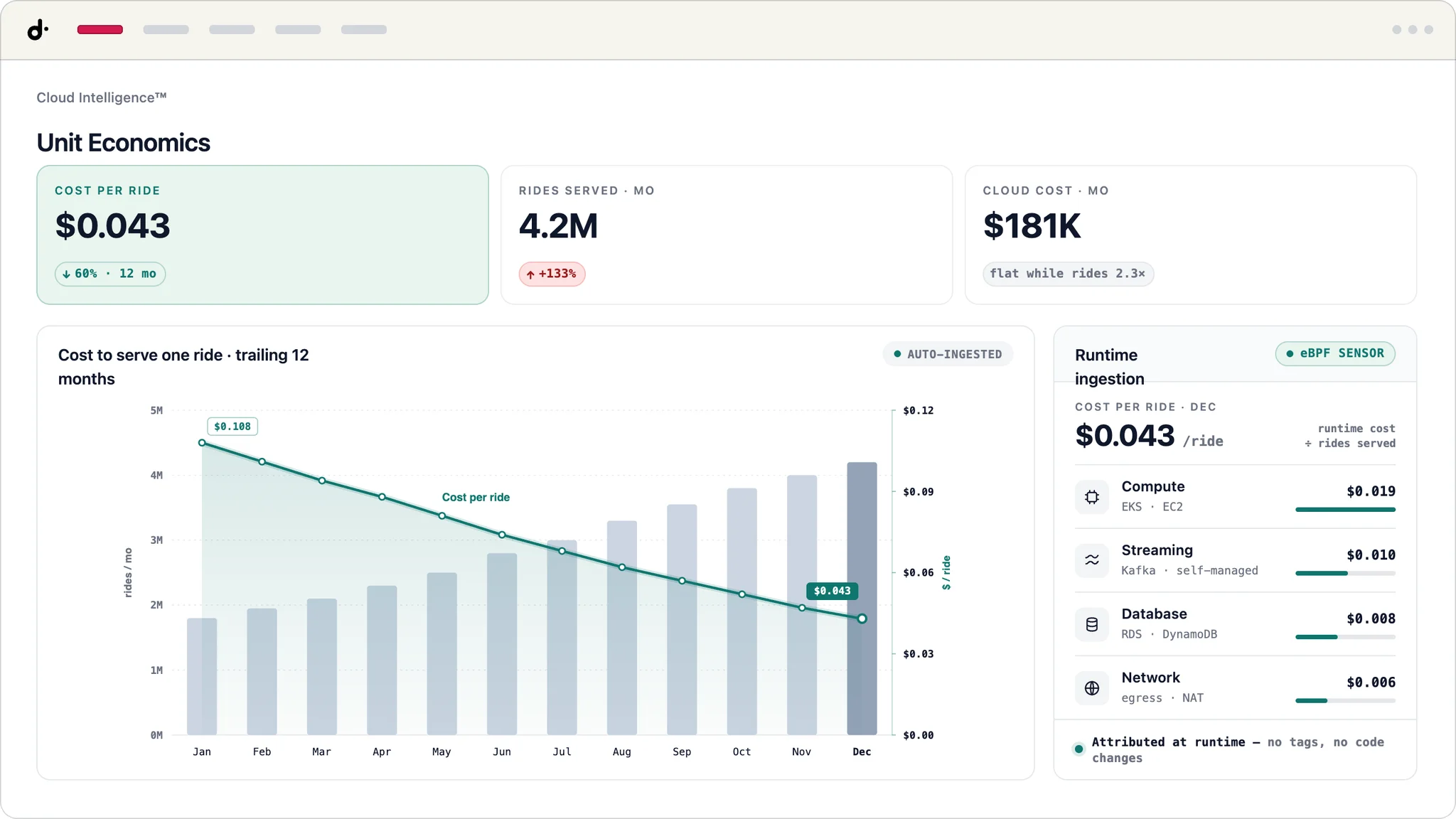
The difference is qualitative. A conventional tool tells you EC2 spend is up 17% month over month — a number without context that sends your team into days of tag archaeology. Attribute tells you a specific customer's consumption is up $44K on 50M additional tokens, driven by the auto-summary feature that shipped last month. Usage tied to the business activity behind it: finance gets per-customer COGS and margin by tier; engineering gets a precise answer and gets back to building; product gets unit economics for pricing AI capabilities on real margins rather than assumptions.
Get started
Installation takes about 15 minutes. Per-customer, per-feature, and per-team COGS typically land within the first week — no tagging campaign, no data pipeline project, no code changes.
