
Track Cloud Costs Per Customer, Even Where Tags Can't Reach
A practitioner's guide with working SQL for CUR 2.0, BigQuery billing exports, and Azure FOCUS, plus what to do where tagging breaks.
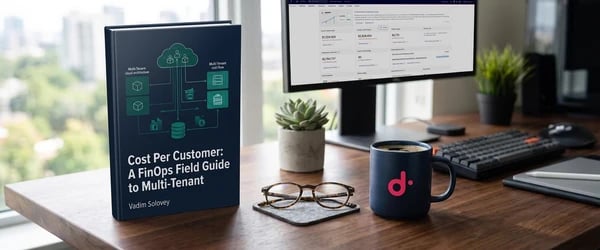
One publicly traded work management SaaS leader found 360 unprofitable accounts hiding inside blended gross margin, roughly $1.3M in negative-margin revenue. This guide walks you through building per-customer cost visibility with native cloud tooling first: CUR 2.0 with Athena, BigQuery billing exports, and Azure Cost Management with FOCUS. Then it names the structural gap that tags can't close: shared GPUs, LLM gateways, and multi-tenant databases.
Get Your Copy of the Guide
Fill in a few details to get instant access.
Written by
Founded DoiT in 2011 and have been here ever since — in every flavor of CTO, co-CEO, and now CEO. I started my career in 1999 building data centers before anyone called it "the cloud," and I've spent the two decades since trying to deliver on what the cloud was actually supposed to be. I still write code most weeks.

01
Who caused the egress charges?
Egress, cross-AZ, and NAT charges carry no workload identity in the bill. The guide covers how teams investigate these today with flow logs, and how runtime measurement cuts that work from hours to minutes.
02
How do I calculate gross margin per customer?
Gross margin per customer equals revenue minus that customer's attributed cloud COGS, including their share of shared compute, databases, storage, and network. The guide shows how to build each input.
03
What closes the shared-infrastructure gap?
Runtime telemetry measures consumption at the kernel and maps every dollar, token, and GPU-hour to the customer that drove it. No tags, no SDKs, no code changes.
Frequently asked
questions
We already run a cost management platform. Won't better tagging discipline get us there?
Tagging works well for dedicated resources, and the guide teaches a full taxonomy for exactly that reason. The limit is structural, not operational: a tag identifies a resource, but it can't split a shared GPU or multi-tenant database across the customers using it. One VP of Engineering eliminated tagging work across thousands of resources and redirected the team to platform projects.
Can't we split shared costs proportionally by revenue or request count?
Proportional splitting is a legitimate FinOps method, and the guide covers it honestly. The risk is that assumption-based splits smooth away the outliers. Measured consumption is what surfaced 360 unprofitable accounts that blended allocation had hidden.
Is this guide just a product pitch?
No. Most of the guide is working SQL and allocation technique using native tooling: CUR 2.0 with Athena, BigQuery billing exports, and Azure Cost Management with FOCUS. Telemetry-based attribution appears only where tagging structurally can't work, framed within the FinOps Framework's Automation, Tools, & Services category.
Does per-customer attribution require installing something heavy?
The runtime approach uses a lightweight eBPF sensor that installs in 15 minutes and produces per-customer COGS the same day. One team deployed across EKS clusters and VMs on AWS and GCP and reached actionable insights in under 2 weeks. Compare that with tagging projects that run for months.
Does this cover LLM and AI spend too?
Yes. Token spend across OpenAI, Anthropic, Bedrock, and Gemini never appears in any cloud bill, which makes it invisible to tag-based allocation. The guide explains how runtime measurement maps token spend to the feature, customer, and agent that drove it.
Where can I learn more?
- AI cost attribution: why tagging can't answer the CFO's question · Blog Posts
- Kubernetes Intelligence by DoiT: Optimize Costs in AWS & GCP · Blog Posts
- Automating Cloudwatch Agent installation and Configuration with Systems Manager and Event Bridge · Blog Posts
- Google Kubernetes Engine without going NAT with kubeIP! · Blog Posts