




Jupiter schließt mit DoiT eine Transparenzlücke von 20 bis 40 % bei den Infrastrukturausgaben
- 26
- Eingebundene Anbieterdaten
- From 60% to 100%
- Datenabdeckung
Diese Seite ist auch in English, Español, Français, Italiano, 日本語 und Português verfügbar.
Raptive wird jetzt sechs Monate im Voraus gewarnt, bevor eine RDS-Engine ausläuft – und vermeidet so rund 10.000 $ überraschende Kosten pro Jahr.

Wer etwas auf Amazon RDS betreibt, kennt das Muster: Eine Engine-Version, die jahrelang reibungslos lief, rutscht klammheimlich aus dem Standardsupport – und plötzlich steht man vor der Wahl zwischen einem erzwungenen Upgrade und einer saftigen Rechnung für Extended Support.
Die Preise für AWS Extended Support greifen in dem Moment, in dem eine Major-Version ihr EOL erreicht – und sie haben es in sich: Auf die normalen RDS-Kosten kommt ein Aufschlag pro vCPU-Stunde obendrauf, automatisch berechnet für jede Instanz, die noch auf einer nicht unterstützten Version läuft. Bei einer Flotte mit nennenswerter Größe kann ein um nur ein Quartal verpasstes EOL-Datum schnell zu fünf- oder sechsstelligen Beträgen an vermeidbaren Kosten führen.
Die Informationen stehen zwar alle in der AWS-Dokumentation, aber das Ganze über eine Flotte unterschiedlicher Datenbank-Engines hinweg im Blick zu behalten, ist genau die Art von Fleißarbeit, die niemand wirklich angeht, bis etwas kracht – zumal Wartungsfenster für geschäftskritische RDS-Datenbanken vonseiten des Business meist nicht verhandelbare Vorlaufzeiten mit sich bringen.
Genau an diesem Punkt stand Raptive. Das Team hatte begonnen einzuschätzen, was es bedeuten würde, veraltete RDS-Engines flottenweit manuell zu dokumentieren und nachzuverfolgen – ein zeitintensiver Aufwand ohne eingebauten Mechanismus, um bei neuen EOL-Daten am Ball zu bleiben.
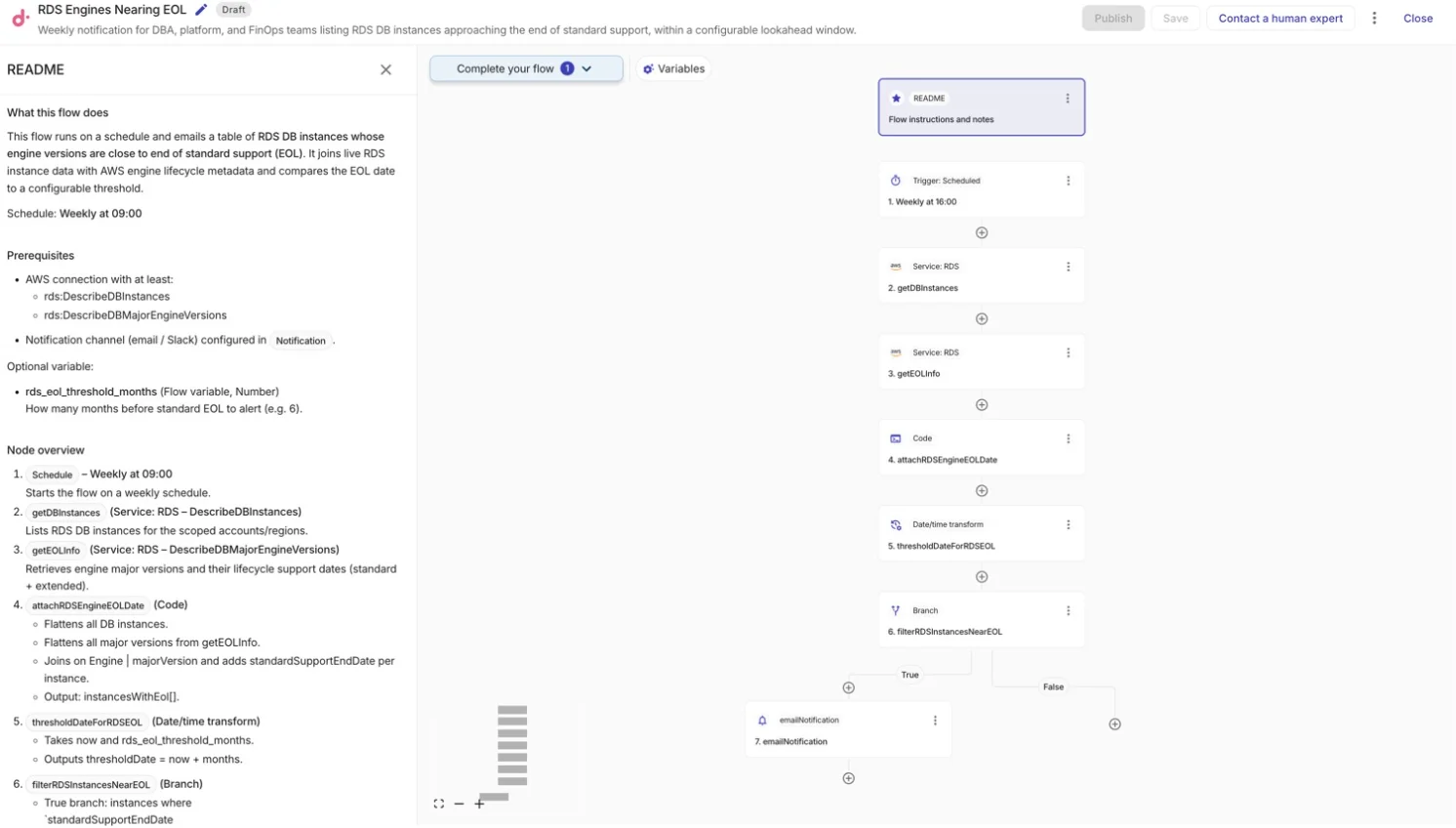
Statt ein eigenes Tracking-System aufzubauen und zu pflegen, setzte Raptive auf CloudFlow – die Automatisierungs-Engine von Cloud Intelligence™ für FinOps- und CloudOps-Workflows.
Für Raptive ging es darum, RDS-Engines, die sich dem Ende des Standardsupports näherten, über die gesamte Flotte von mehr als 30 Datenbanken hinweg zu überwachen.
Das Team setzte ein DoiT CloudFlow-Template ein, das genau das nach Zeitplan automatisiert. Der Flow scannt alle RDS-Instanzen über sämtliche Accounts und verfügbaren AWS-Regionen hinweg und schickt einen Alert an eine vordefinierte Empfängeradresse, sobald eine RDS-Engine innerhalb der nächsten sechs Monate (konfigurierbar) das Ende des Standardsupports erreicht.
Heute läuft der Flow im Vollbetrieb und liefert Raptive wöchentliche Reports darüber, welche Datenbank-Engines noch auf Versionen nahe dem Support-Ende laufen.
Mit den neuen RDS-End-of-Life-Alerts von CloudFlow können wir deutlich proaktiver dafür sorgen, dass unsere Datenbank-Instanzen aktuell bleiben. Wir bekommen frühzeitig intern Transparenz und können Upgrades in Ruhe vorbereiten, statt sie unter Druck durchziehen zu müssen und dabei auch noch Extended-Support-Kosten zu zahlen.
Jon Fairbanks, Site Reliability Engineering Manager
Da Raptive jetzt rechtzeitig erfährt, welche RDS-Engines bald veralten, kann das Team Upgrades vorausschauend planen – statt erst loszulegen, wenn der Support bereits ausgelaufen ist.
Sechs Monate Vorlauf machen aus einem Notfall eine Planungsaufgabe. Die Engineering-Teams haben Spielraum, Wartungsfenster zu terminieren, die Anwendungskompatibilität zu testen und Upgrades zu eigenen Bedingungen durchzuführen, statt in der Woche des Support-Endes per Pager geweckt zu werden.
Heute deckt der Flow automatisch über 30 RDS-Instanzen in allen AWS-Regionen von Raptive ab und hat dem Unternehmen geholfen, rund 10.000 $ jährliche Extended-Support-Kosten zu vermeiden, die andernfalls klammheimlich aufgelaufen wären.
Raptive muss keine Engineering-Ressourcen mehr dafür einsetzen, ein solches Tracking-System inhouse zu bauen oder zu pflegen, und kann sich darauf verlassen, dass Cloud Intelligence™ den Flow langfristig am Laufen hält.
Sie möchten das in Ihrer eigenen Umgebung einrichten? Das Template "RDS Engines Nearing EOL" ist direkt in Cloud Intelligence™ verfügbar. Einfach CloudFlow öffnen, auf den Tab "Templates" klicken und nach "RDS Engines Nearing EOL" suchen – fertig.
Mehr über CloudFlow und Cloud Intelligence™ erfahren
Sparempfehlungen, Ressourcenplanung, ungenutzte Ressourcen – automatisch umsetzen.







On integrating DataHub, the DoiT team was very hands-on to the point where DoiT support put together the first ingestion script and pipeline to unlock us.
Kyle Espinola, Head of Platform Engineering

“PerfectScale gives us the confidence to automate Kubernetes optimization while letting our engineers focus on building what matters.”
Josh Zarrabi, Infrastructure Engineer

“Without PerfectScale by DoiT, I don't know how we would do it. We'd have to have twice the number of people on my team to stay on top of it. With PerfectScale, we can focus on the more strategic issues.”
David Adkins, Director of Software and Platform Engineering

Connecting IBM and AWS privately was the piece we needed to get right, and we wanted to move faster on it than we could on our own. DoiT worked through the options with us, found the subnet overlap that was breaking the routing, and made it stable. That unblocked everything else.
DevOps Lead, Software Projects

Attribute™'s platform is truly unique. We now have crystal-clear visibility into our cloud spend at the workload and tenant level, and that insight has already led to actionable savings and powerful insights as we further scale our service.
Paul White, VP of Engineering, Shasta Cloud
We have worked with DoiT for many years, and there has been an increasing number of capabilities and features in DoiT Cloud Intelligence. We've embedded features such as Cloud Analytics and Reports in our own FinOps processes, it's become core to what we do.
Martin Lee, Director of Operations

DoiT gave us the confidence to move from experimentation to production. They helped us understand the right way to build AI for the real world.
Milad Rezazadeh, CTO
Attribute™'s cost grouping technology took our cost visibility and allocation to a whole new level. Now, our teams are fully accountable for their budgets, significantly improving our cloud efficiency and helping us minimize unnecessary costs.
Eli Zilbershtein, Head of DevOps, Hippo

You can't tag a customer in a multi-tenant environment. Attribute™ finally shows us what each customer costs and what's driving those costs.
Omri Cohen, Director of Engineering, Platform

Attribute™'s data is truly unmatched. No other solution on the market could deliver the precise customer cost and usage profiles we needed in such a complex infrastructure. Within weeks, the data from Attribute™ transformed our understanding of cost structures, influencing key strategic decisions in pricing, renegotiations, and market positioning.
Jonathan Langer, COO, Claroty

Attribute™ simplified tracking customer costs in our multi-tenant environments. Customer cost measurement is now clear and standardized, and finance gets the business context they need. Integration was quick and required no changes.
Kfir Lippmann, CFO, Salt Security

Attribute™ translates complex cloud bills into actionable, business-centric insights that empower our engineering teams to take true ownership of their costs.
Balamurugan Mohandossgandhi, Head of IT and Infrastructure, PropertyGuru

This has let us get a better idea of what our cost of goods sold really is. It's not every day you come across something that delivers value as quickly as yours did for us. I was seeing useful insights inside the POC, and we had only deployed it to a couple of real clusters.
Jason Moore, Principal DevOps Engineer, Accrete AI
Let us show you what ships this week.