

BigQuery can execute large, expensive queries in seconds. When something goes wrong, costs can accumulate just as quickly, often before anyone has a chance to notice.
Real-time cost anomaly detection for Google BigQuery is designed to address that gap. It provides near real-time visibility into unexpected BigQuery cost behavior across both on-demand and reservation workloads, allowing teams to identify and stop issues before they spiral out of control.
Why BigQuery Cost Anomalies Are So Hard to Catch
Most FinOps tools rely on next-day billing file ingestion. This means that if a bad query ran at 10:00 AM today, you wouldn’t be alerted about it until tomorrow morning, after it had been racking up charges for nearly 24 hours. And if that delay spans a weekend or off-hours period, the financial impact can be even more significant.
To combat this delay, DoiT’s real-time anomaly detection for BigQuery analyzes live usage metadata instead of waiting for billing exports.
Once enabled, this feature:
- Continuously analyzes BigQuery usage patterns
- Detects abnormal or unexpected behavior
- Estimates cost impact in near real time
- Sends Slack or email alerts in under an hour, not the next day
This applies to both BigQuery on-demand and reservations, giving teams visibility across all of their BQ workloads.
A Real-World Example: A Cost Spike Caught Before It Escalated
A customer received a real-time BigQuery anomaly alert and immediately opened a P1 ticket so we could investigate together. Under normal conditions, they wouldn’t have seen this issue until at least the next day—which, in this case, would have been late on a Friday afternoon.
What the Anomaly Looked Like
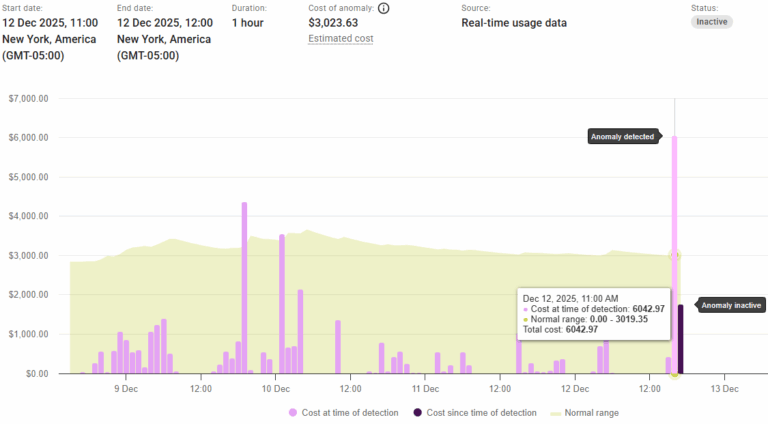
This customer’s typical on-demand BigQuery usage tops out around $3,000 per day, clearly visible in the anomaly detection interface.
Then, on the day of the alert, a short burst of activity caused costs to spike to $6,000, nearly double the customer’s normal maximum. The spike was brief, but significant enough that DoiT’s real-time detection engine flagged it and sent an alert.
Watch the video below for a detailed walkthrough of the real customer example, and how real-time anomaly detection prevented a costly BigQuery incident before it escalated.
Identifying the Root Cause in Minutes
When we investigated, we found that 122 BigQuery jobs were running simultaneously, all on-demand. Every job was prefixed with airflow, pointing to either a self-hosted Airflow deployment or Google Cloud Composer.
The jobs were:
- Running far more frequently than expected
- Processing unusually large volumes of data
- Likely triggered multiple times due to a configuration issue
The root cause was a mistyped cron schedule in Airflow.
This is a deceptively common problem. A job meant to run once per day can accidentally run every hour, or even every minute. When that happens, a $100 query suddenly becomes a $2,400 daily expense simply because it’s executing more often than intended.
Because these jobs ran repeatedly and without caching, costs spiked almost immediately – and real-time anomaly detection caught it just as fast.
Why Real-Time Detection Changes Everything
This particular incident occurred on a Friday afternoon at 4:30 PM.
Without real-time detection, the customer likely wouldn’t have noticed anything until Monday morning. If the job had been scheduled even more aggressively (e.g. every minute instead of every hour), the weekend alone could have produced tens of thousands of dollars in unexpected BigQuery charges.
Instead, DoiT flagged the anomaly within an hour. The customer stopped the jobs immediately, preventing a major billing issue before it had time to grow.
More Than Cost Control: Why It Matters
Real-time BigQuery anomaly detection helps teams:
- Catch runaway queries in minutes so that engineering teams can stop inefficient or accidental queries before they rack up serious costs.
- Protect against operational mistakes by getting alerted when misconfigurations or unexpected behavior start impacting spend.
- Strengthen security posture because sudden cost spikes can indicate unauthorized access or compromised systems, rather than just inefficient queries (see this example from last year of some AWS customers who had a malicious actor rack up thousands in unauthorized EC2 charges)
Instead of reacting to yesterday’s bill, teams can now act while the issue is still unfolding.
Take Control of BigQuery Spend In Real Time
BigQuery is incredibly powerful, but even small mistakes can become expensive fast. Real-time cost anomaly detection gives finance, data, and platform teams the visibility they need to stay ahead of risk before costs spiral out of control.