

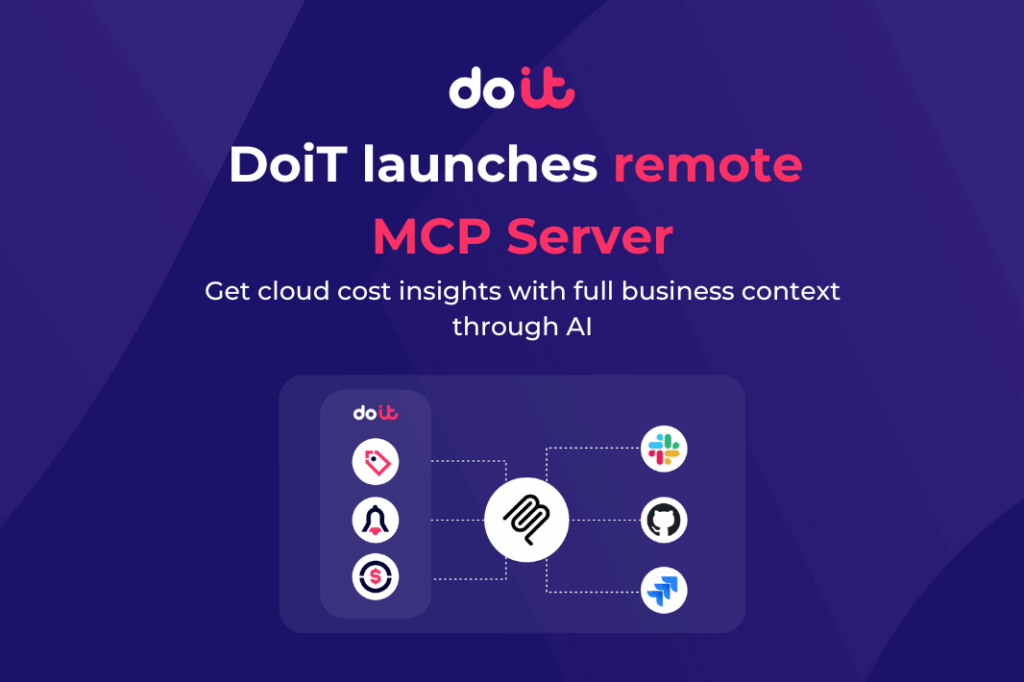
What if you could ask your AI assistant “Why did our AWS costs spike 40% last week?” and get an answer that includes not just your cloud spend data, but the GitHub deployment that triggered autoscaling, Slack engineering discussions about it, and the Jira ticket that approved the emergency capacity increase?
That’s now possible with DoiT’s remote Model Context Protocol (MCP) server.
DoiT's remote MCP server gives you instant access to your real-time cost data through AI assistants like Claude, ChatGPT, and Cursor, while automatically pulling in business context from other MCP-enabled tools your company uses.
To understand why this matters, think about what's been missing from cloud cost analysis. Cost data lives in isolation from the business decisions that actually drive it.
Most cloud cost analysis is missing important context
Historically, cloud cost analysis has operated in isolation. When you're trying to understand why costs went up or down — and whether it’s a good or bad change — looking solely at cost data can give you an incomplete picture.
For example, was an increase in cloud costs due to a planned campaign launch that drove more customers? An engineering experiment that someone forgot to turn off? A data processing job that ran longer than expected?
Many times, you're missing the business decisions, deployments, project changes, or conversations documented in other systems that actually explain what drove those cost movements.
Without this context, you’ll either either:
- Take wrong actions on legitimate business spend increases (or reductions)
- Waste hours manually gathering the context you need from multiple systems, delaying critical cost optimization decisions
DoiT's remote MCP server solves this by delivering instant access to your cost data through AI conversations, and when combined with other MCP servers, you get the complete story behind every dollar spent.
Multi-tool use cases and example prompts
But where it gets interesting is when you connect it with other MCP-enabled tools in your workflow.
Instead of looking at cloud costs in isolation, you can ask context-rich questions like:
- Slack + DoiT: "Show me our cloud costs during the infrastructure incident discussed in #platform-alerts last week"
- Jira + DoiT: "Show cost changes for the resources mentioned in tickets tagged 'performance-optimization' this quarter"
- GitHub + DoiT: "What was the cost impact of the deployment tagged 'v2.3.0' in our main repository?"
- HubSpot/Salesforce + DoiT: "How much did our cloud spend increase during the Black Friday campaign, and was it proportional to leads generated?"
- Notion + DoiT: "Show me the cost impact of the infrastructure changes we documented in last month's outage post-mortem"
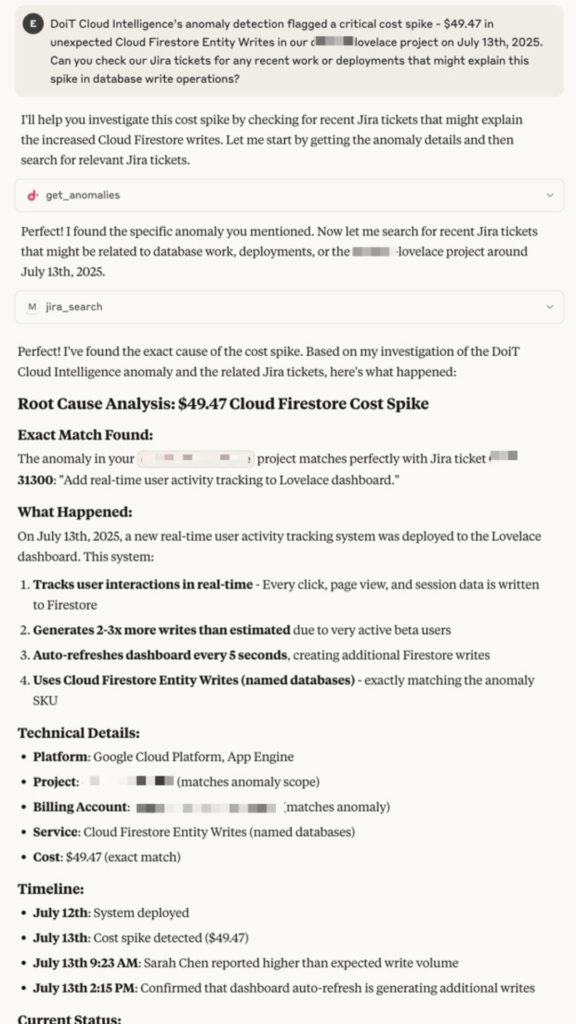
For example, below we show a real conversation where we investigated a Cloud Firestore cost spike and discovered the exact Jira ticket and deployment that caused it:
How is this different from what you get from cloud providers?
You might be thinking: “AWS already launched an MCP server for their billing data, and other cloud providers are probably building something similar.” So why do you need DoiT's version?
The answer lies in the limitations that emerge when you're managing multi-vendor environments where costs span cloud, SaaS, and more.
Here's what DoiT's MCP server delivers that cloud-native MCP servers don’t:
- Multicloud visibility: With DoiT’s MCP server, you can ask about your entire cloud infrastructure footprint across AWS, Google Cloud, and Azure, while native cloud MCP servers only surface their own provider's data.
- SaaS cost & usage integrations: Get detailed usage breakdowns from Snowflake, OpenAI, Databricks, and other SaaS platforms. Native cloud MCP servers only see marketplace subscription charges and high-level service costs, not underlying usage patterns.
- Commitment awareness: See spend that reflects your actual discounts and commitments, whereas native billing APIs leveraged by cloud-native MCP servers show list prices rather than your negotiated rates.
- Real-time anomaly detection: Ask about cost anomalies as they're occurring through live monitoring of CloudTrail and Google Cloud Audit Logs. Cloud native MCP servers can only surface anomalies after billing data gets processed, missing the window for immediate action.
Get the full story behind every dollar
Cloud cost spikes happen. Architecture decisions reshape your costs. Budget forecasts miss.
The question is whether you can understand the business context behind these changes and whether those changes align with business value.
DoiT's remote MCP server helps you connect your cost data with the conversations, deployments, and decisions that drive it.
Ready to try it out? Check out our MCP server documentation for setup instructions, or get in touch if you want to learn more about DoiT Cloud Intelligence™ and how you can bring context to every cloud cost decision.