
Cloud Intelligence™
Tokens Are Easy to Count. Context Is Harder
This page is also available in Deutsch, Español, Français, Italiano, 日本語, and Português.


About Amit Kinha
Field CTO
Today at DoiT. Field CTO and FinOps Foundation Governing Board Member. I work with large enterprises on the gnarly parts of running cloud at scale, and lead Product Marketing across DCI, PerfectScale, Select.dev, and the Partner Platform. Previously ran Cloud FinOps at Citi ($150M/yearly spend) Citigroup, and shipped backend systems at Goldman Sachs (Marcus, Apple Card).
Where to catch me. Co-hosting the Applied FinOps podcast with Frank Contrepois, speaking at conferences like AWS re:Invent, Google Cloud Next, Microsoft Ignite, and FinOps X, and showing up at FinOps meetups whenever I can. If you're a FinOps practitioner with a battle story, I want to hear it.
FinOps Foundation. Currently a Governing Board Member. Previously sat on the FOCUS Steering Committee (the open billing-data standard) and served as a FinOps Ambassador.
Citi (2021-2025). Global Head of Cloud FinOps. Built the function from one engineer to a global team, covering CSPs and Data Cloud (Snowflake, MongoDB Atlas) at roughly $150M/year of spend under management.
Goldman Sachs (2014-2021). Backend engineering on large-scale consumer products. Worked on Marcus (consumer lending) and Apple Card (consumer accounts, statements, and the rewards service that talked to Green Dot Bank).
Off the clock. Reading, and trying to convince myself I'm a better poker player than I actually am.
My personal pageBefore I was a Field CTO at DoiT, I was a FinOps practitioner. I've written tagging policies. I've chased untagged resources the week before a budget review. I've built chargeback models that were technically defensible and still started a fight in every meeting, because somebody's shared cluster didn't split the way their P&L did.
So when we launched Attribute™ this week, I understood why the conversation leads with tokens: input, output, cached, reasoning. Cost per request, per customer, per feature, per agent. That framing is correct. I just don't think it's complete.
Tokens are easy to count. The harder question is why they existed at all. Did a customer adopt a new AI feature? Did an internal workflow quietly switch to a more expensive model? Is one prompt burning ten times the tokens it needs? Did an agent spawn hundreds of downstream tasks nobody asked for? In a cost report, those four scenarios look nearly identical. To the business, they couldn't be more different.
Tagging was never the goal
Here's something practitioners know that rarely gets said out loud: nobody ever wanted tags. What we wanted was accountability — the right people seeing the right cost information in time to act on it. Tagging was just the best implementation of accountability for the architecture we had. When a VM served one application and an account mapped to one team, ownership, consumption, and accountability lined up. Tags worked because the architecture let them work.
Then the architecture changed. Kubernetes made infrastructure shared. Serverless made it abstract. Managed services moved spend into requests, queries, and invocations. Vadim has written about why instrumentation breaks down and Josh has covered exactly where tagging fails, so I won't re-argue it here. The short version: the thing being billed and the thing creating the demand drifted apart, and AI pulled them apart completely. A single model account or gateway can aggregate requests from every product, team, agent, and employee you have. By the time the invoice lands, the context that explains it is already gone.
The same number, four different decisions
This is the part I care about most, because it's the difference between reporting and deciding.
Say your AI spend jumped 40% last month. From my practitioner years, I can tell you what that number supports on its own: nothing. What you do next depends entirely on why it happened.
If it grew because a customer-facing feature is driving adoption and retention, you invest more. That's not a cost problem. It's a growth signal wearing a cost problem's clothes.
If it grew because an internal workflow is using a premium model for a task a smaller model handles fine, you optimize. That's engineering work with a measurable payback.
If it grew because an agent is fanning out unnecessary downstream calls, you govern: rate limits, budgets, controls.
And if it grew because one enterprise customer drives a disproportionate share of your inference cost, that isn't even a FinOps conversation anymore. That's pricing, packaging, and margin — a conversation for your CFO and your product team.
Four causes. Four owners. Four completely different actions. The cost number doesn't tell you which meeting to schedule. The context does.
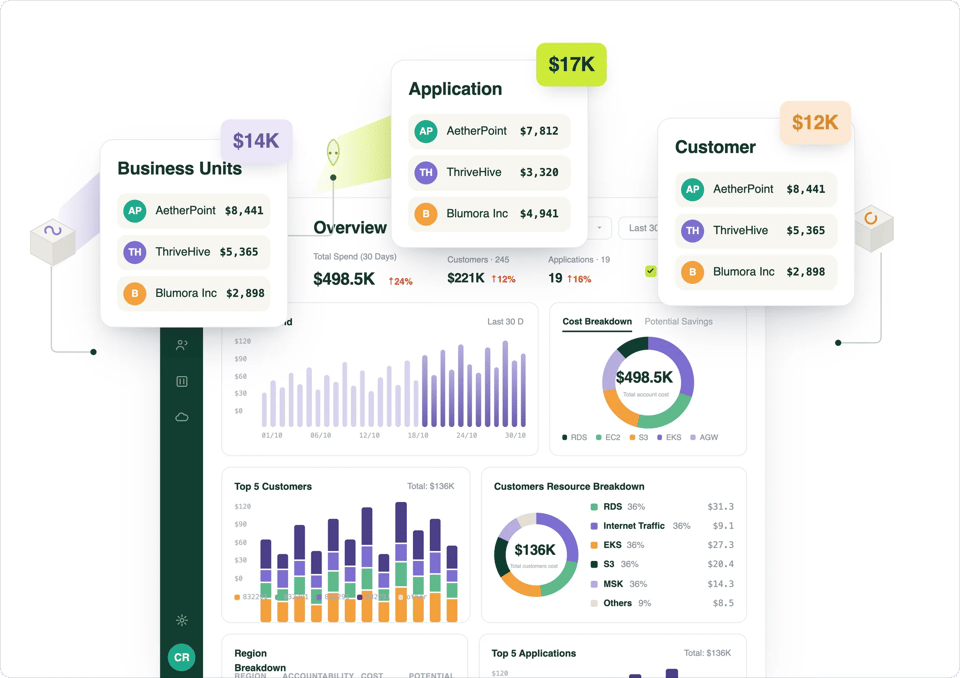
That's what Attribute™ actually changes. Because it measures real consumption at the kernel and joins it with provider billing, the "why" arrives with the number: this customer, this feature, this agent, this workflow. Not because token counting is the point, but because attribution is what turns a number into a decision.
Cloud bill shouldn't be a mystery
One platform for AI and Cloud optimization.
What changes for the practice
In our survey of 500 finance leaders, 79% had already experienced AI cost overruns, and only 15% could calculate AI ROI without significant bottlenecks. I don't read that as a discipline problem. Those teams aren't failing at FinOps. They're running the old playbook against an architecture that defeats it.
What I think comes next, and what I tell customers in the field: FinOps stops being a reporting function that reconstructs context after the fact, and becomes embedded where decisions get made. Engineers see cost implications while they design, not thirty days later. Product teams know the unit economics of a feature before the pricing discussion, not after. Finance connects AI spend to margin per customer instead of staring at one undividable line item. AI platform teams see not just which models ran, but which use cases created value and which created waste.
None of that works without attribution. It's the layer everything else in FinOps sits on, and for AI workloads it's the layer we've been missing.
I spent years of my career reconstructing context after the invoice arrived. The next era of FinOps is having it before the money is spent. That's what this launch means to me.
Fifteen minutes to install. No instrumentation required. Token economics by end of day. Book a demo to see Attribute™ in your own environment.


