
Cloud Intelligence™
How to Measure AI ROI When You Can't See Where the Tokens Went
This page is also available in Deutsch, Español, Français, Italiano, 日本語, and Português.


About Josh Palmer
Head of Content
I'm Josh Palmer, Head of Content at DoiT, where I split my time across multiple business units including DoiT Cloud Intelligence, PerfectScale (Kubernetes cost optimization), and SELECT (Snowflake, Databricks, and BigQuery cost optimization). Before DoiT, I spent four and a half years at OnBoard building content for a board intelligence platform used by 6,000+ organizations, and before that, two years as Content Marketing Manager at Zylo, a SaaS management platform.
My personal pageEighty-three percent of enterprises expect a return on their AI investment within 12 months. Only 15 percent can calculate AI ROI without significant bottlenecks. That's according to our research, a survey of 500 finance leaders conducted by Sapio Research. The gap isn't a patience problem or a maturity problem. It's a measurement problem, and it starts with a piece of math most finance teams haven't questioned yet.
What AI ROI measurement means today
AI ROI measurement is the practice of tying AI spend to the outcomes it produces, revenue impact, retention, productivity gains, cost savings, and expressing that relationship as a return finance can act on. In practice, it usually breaks into a few core components.
Cost tracking. Establishing what was actually spent: tokens consumed, compute used, the infrastructure behind a given model or feature. Understanding how an LLM actually processes a request is a useful starting point for seeing where that cost actually originates.
Value attribution. Connecting that spend to a business outcome, a renewal, a productivity gain, a feature that drives upsell, a support ticket deflected.
Payback period calculation. Translating the cost-to-value relationship into a timeframe finance recognizes: when does this investment break even, and when does it start generating return.
Ongoing margin monitoring. ROI isn't a one-time calculation. As usage scales, cost per outcome can drift, sometimes favorably, sometimes not, and a program needs to track that drift continuously rather than rely on a quarterly snapshot.
For AI investments with a clean, bounded scope, a dedicated model serving a single feature, a clearly licensed tool with a fixed monthly cost, this math is usually straightforward. DoiT's Eduardo Mota has walked through a practical 5-step ROI evaluation framework for exactly these cases. The problem starts elsewhere.
Why the standard ROI formula breaks on the cost side
ROI is supposed to be a simple ratio: value generated divided by cost incurred. Most teams assume the hard half of that equation is the value side, proving that an AI feature actually moved a business metric. In practice, the harder half is usually the cost side.
You can typically identify the outcome. A renewal happened. A support ticket got deflected. A feature shipped and adoption went up. What's much harder to pin down is what it actually cost to produce that outcome, because AI spend rarely shows up as a clean, attributable number.
This is the same attribution problem that breaks FinOps for AI, applied to a finance question instead of a cost-management one. A managed model API serves dozens of teams from one billing line. A shared GPU cluster runs inference for several products at once. An LLM gateway aggregates traffic and strips out the caller's identity before it reaches the provider. An agentic workload spawns sub-agents that trigger real infrastructure costs with no clean link back to the feature that triggered them.
ROI measurement is an attribution problem wearing a finance costume. If you can't attribute the cost, you can't calculate the ratio. You can only estimate it, and estimates compound error in exactly the direction that makes AI investments look worse, or better, than they actually are.
Where the old ROI playbook holds, and where it doesn't
Account-level billing tells you total spend, not per-feature cost
A provider invoice tells you what the organization spent on a model last month. It doesn't tell you what your renewal-driving feature cost versus your experimental one that hasn't shipped yet. Without that split, every ROI calculation defaults to an organization-wide average, which tells you almost nothing about whether a specific investment is paying off.
Shared infrastructure makes the denominator unreliable
When a GPU cluster or model account serves multiple products, the cost denominator in your ROI ratio is built on an allocation assumption, not a measured number. Change the assumption and the ROI changes with it, even though nothing about the actual business outcome moved.
Fast-moving agentic workloads make last quarter's model obsolete this quarter
An agentic feature can change its own cost profile overnight, spawning more sub-agents, calling more expensive models, running longer chains, without anyone updating the ROI model that was built when the feature shipped. By the time finance notices the unit economics have shifted, several months of decisions may have been made on stale numbers.
A concrete example: the $44K surprise
A product team ships a new AI feature tied to a major release. The feature performs well. Adoption is strong. Then finance closes the month and finds a $44,000 line item increase tied to the feature, far beyond what anyone modeled at launch.
Nobody mis-forecasted on purpose. The model that priced the feature's AI cost assumed a per-user token estimate based on early testing. In production, usage patterns differed: longer sessions, more complex prompts, a subset of power users driving disproportionate consumption. None of that was visible until the bill landed, because nothing in the stack was attributing cost at the level of detail needed to catch it earlier.
This is the scenario that makes AI ROI measurement a board-level concern rather than a finance housekeeping task. The feature might still be a good investment. Nobody can say for certain, because nobody can see the cost side clearly enough to finish the math.
Cloud bill shouldn't be a mystery
One platform for AI and Cloud optimization.
ROI measurement before and after token-level attribution
| Account-level estimation | Kernel-level attribution | |
|---|---|---|
| Cost visibility | Total spend per provider or account | Cost per token, per feature, per customer |
| Time to detect a problem | End of billing cycle, often a month or more | Near real time, as consumption happens |
| Confidence in the number | Built on allocation assumptions | Built on measured runtime consumption |
| Who can act on it | Finance, after the fact | Finance and engineering, while it's happening |
Token-level attribution as the foundation for ROI
You can't calculate a ratio you can't measure. Token-level attribution doesn't just make ROI calculations more precise, it makes them possible in the first place for the workloads where account-level billing was always going to be a guess.
Attribute™ by DoiT deploys an eBPF sensor inside the operating system that observes actual consumption, every token, every model request, every GPU cycle, as it happens, and maps each unit back to the process, container, and request responsible. No tags. No SDKs. No code changes. The same kernel-level approach that solves cost allocation for FinOps for AI is what makes ROI measurement reliable rather than estimated: cost per feature, cost per customer, and cost per outcome, attributed automatically rather than reconstructed after the bill lands.
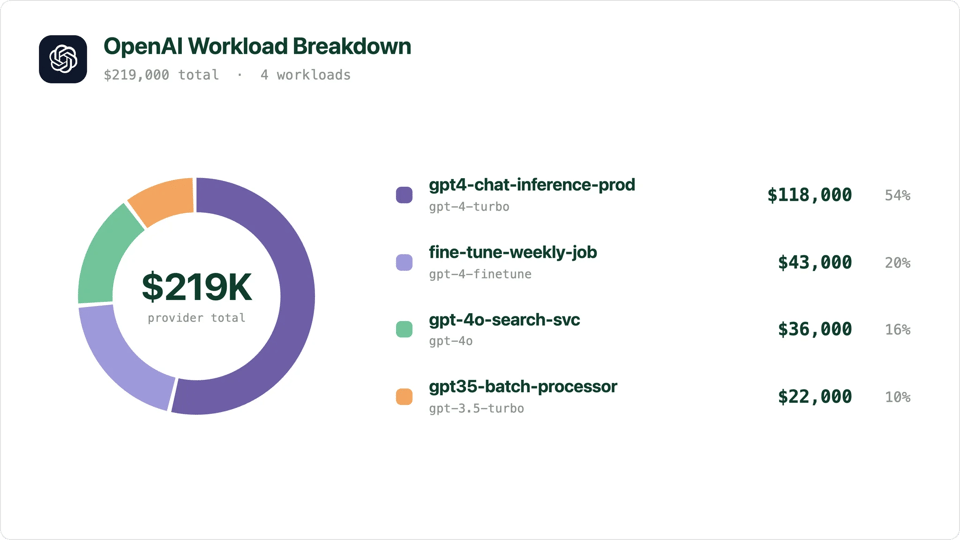
This is the same architectural principle behind our FinOps for AI approach, applied to the finance question rather than the cost-management one. Tokenomics without tags, SDKs, or code changes.
Why this matters now
Those two numbers describe the gap from two angles: expectation and capability. A third, from the same Sapio Research survey, describes the consequence: 79 percent of enterprises have already experienced AI cost overruns.
DoiT has managed more than 8 billion dollars in cloud spend for 4,500 customers across 27 countries, and we've watched the same pattern play out across every cost category that's emerged in cloud: the organizations that establish accurate measurement early make every subsequent investment decision better. AI ROI is no different, except the cost of waiting compounds faster.
We're working with the Tokenomics Foundation, alongside JR Storment and the FinOps Foundation, to help define what reliable AI cost measurement looks like for the industry.
FAQ
What is AI ROI?
AI ROI is the return generated by an AI investment relative to its cost, expressed as a ratio or a payback period. It requires two reliable numbers: the value produced and the cost incurred. Most AI ROI measurement problems trace back to unreliable cost data rather than unclear value data.
How do you calculate AI ROI?
The standard approach divides the value generated by an AI investment, revenue, savings, productivity gains, by the cost of running it. The calculation is straightforward once both numbers are reliable. For most organizations, the value side is identifiable. The cost side often isn't, particularly for AI workloads running on shared infrastructure or through LLM gateways.
Why is AI ROI so hard to measure?
AI spend frequently runs through shared GPU clusters, LLM gateways, and agentic workflows that don't preserve a clean link between cost and the feature, customer, or team responsible for it. Tags and SDKs, the tools traditionally used to attribute cloud cost, don't survive these architectures, which leaves the cost side of the ROI equation built on estimates rather than measurement.
What's the difference between AI cost management and AI ROI measurement?
AI cost management focuses on tracking and controlling what's being spent. AI ROI measurement goes a step further, connecting that spend to the business outcome it produced and expressing the relationship as a return. ROI measurement depends on having reliable cost management as a foundation; without accurate cost attribution, ROI calculations default to estimates.
How long does it take to see ROI on an AI investment?
It depends on the use case, but most enterprises expect a return within 12 months according to industry research. Whether that timeline is met or missed is often unclear until cost attribution is in place, since many organizations can't confidently calculate ROI at all until they can see cost at the feature or customer level.
Who owns AI ROI measurement inside an organization?
It typically sits jointly between finance, who own the return calculation and the investment case, and engineering or product, who understand the workload behind the cost. Neither side usually has full visibility alone. Finance needs engineering's context on how the spend is generated, and engineering needs finance's framing of what counts as return.
Can you measure AI ROI without tagging every AI workload?
Yes. Kernel-level measurement observes consumption at the operating system level, which means cost attribution doesn't depend on whether a workload was tagged correctly or could be tagged at all. This matters most for the workloads tagging was never going to reach: shared GPU clusters, gateway-routed traffic, and agentic chains.
Ready to see your true AI cost-to-serve?
Fifteen minutes to install. No instrumentation required. Token economics by end of day.


