
Announcement
AWS Waiters now supported in CloudFlow
By Craig Lowell

CloudFlow steps can now poll AWS resources until they reach a desired state, eliminating race conditions and replacing arbitrary sleep statements with deterministic, tunable waiters.
CloudFlow steps that call AWS APIs can now include “Waiters” – built-in polling mechanisms that block execution until a resource reaches a specified state (for example, an EC2 instance enters “running,” or a CloudFormation stack reaches “CREATE_COMPLETE” state).
The flow does not advance until the waiter confirms the target condition, eliminating timing-related race conditions and “false-positive” successes.
Why this matters:
- Deterministic pipelines: By making each step state-aware, you remove arbitrary sleep statements and ad-hoc retries. That yields predictable, repeatable deployments and fewer flaky builds.
- Lower failure rates: Waiters leverage AWS service-specific back-off logic and error handling, so you avoid cascading errors caused by resources that are still provisioning.
- Tunable latency: The default poll interval is 15 seconds, but you can override
MinDelay,MaxDelay, andMaxAttemptsto balance pipeline speed against API call volume. - Cost-efficient polling: Purpose-built waiters replace tight loops or aggressive custom polling, reducing superfluous API calls and the associated request charges.
- Optimized resource billing: Downstream tasks start only when prerequisites are truly ready, so you don’t keep compute, container, or runner capacity idle while waiting for eventual consistency.
- Predictable spend: More deterministic execution times make it easier to forecast run-time costs and spot anomalies.
To enable a waiter, add the waiter configuration block to any CloudFlow step that invokes an AWS API.
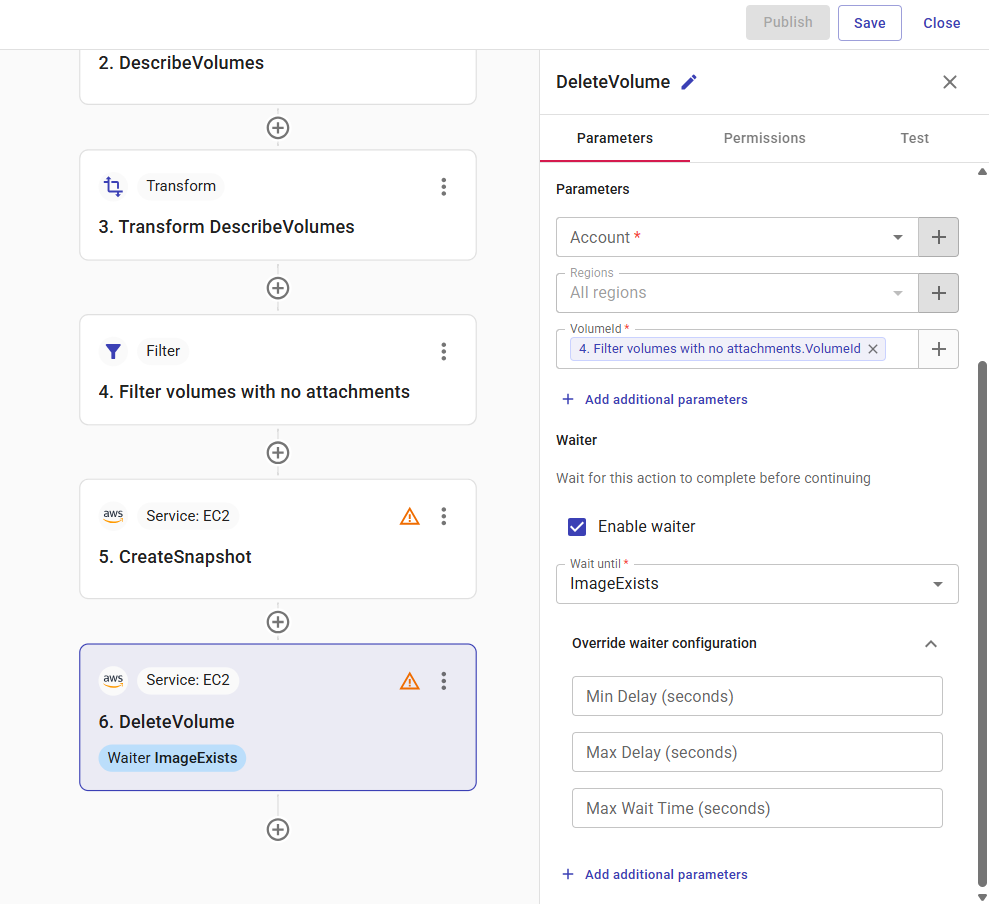
To learn more about how to apply AWS Waiters, check out our Help documentation or raise a ticket with the DoiT support team.
Related documentation